Digestive Capacity: The Missing Link Between Intake and Impact
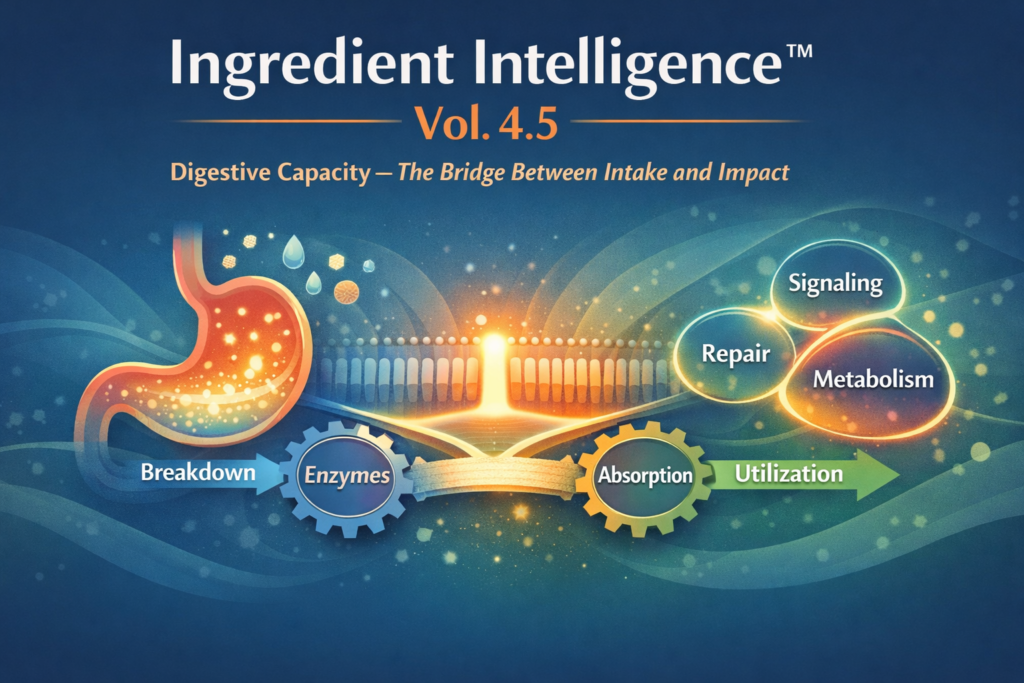
✴️ INGREDIENT INTELLIGENCE™ | VOL. 4.5
Hydrochloric Acid & Digestive Enzymes
Most nutrition conversations assume a simple equation:
what you consume = what your body uses.
But biology doesn’t work that way.
Between intake and impact sits a critical, often-overlooked system: digestive capacity.
Why Digestive Capacity Matters
Digestive capacity determines whether food and supplements ever become biologically available substrates. Without sufficient breakdown, signaling and absorption never fully occur — regardless of diet quality or supplement sophistication.
This is why two individuals can consume identical meals and experience radically different outcomes.
From a systems homeostasis perspective, digestion is not about symptoms like bloating or reflux. It is about throughput — the system’s ability to convert external inputs into usable internal signals and structures.
Hydrochloric Acid: The Gatekeeper Signal
Stomach acid is more than a digestive fluid. It is a coordination signal.
Adequate hydrochloric acid:
- initiates protein denaturation
- triggers downstream enzyme release
- supports mineral ionization (iron, zinc, calcium, magnesium)
- provides antimicrobial containment
- signals appropriate gastric emptying
Low or inconsistent acid disrupts this entire cascade, increasing signal noise throughout the GI–immune–metabolic axis.
Digestive Enzymes: Throughput, Not Stimulation
Digestive enzymes do not “boost” digestion — they restore mechanical efficiency.
Their role is to:
- complete macronutrient breakdown
- reduce fermentable residue
- lower immune activation from partially digested substrates
- improve substrate availability for tissue repair and energy production
In systems terms, enzymes reduce processing friction, allowing digestion to occur with less compensatory stress.
Why This Is a Bridge Volume
Volume 4.5 exists for a reason.
Neurotrophic signaling (Vol. 4: Lion’s Mane) requires substrates.
Structural and metabolic repair (Vol. 5: Essential Amino Acids) requires absorption.
Digestive capacity is the bridge between signaling and structure.
Without it:
- advanced compounds underperform
- nutrition appears inconsistent
- downstream interventions seem unpredictable
This is not a failure of ingredients — it is a failure of throughput.
Systems Homeostasis Takeaway
Digestive support is not supplementation in the traditional sense. It is restoring access.
You cannot signal, build, or repair with nutrients you never absorb.
Digestive capacity doesn’t promise outcomes.
It removes bottlenecks so systems can coordinate effectively.
Where This Fits in the Series
- Vol. 4 — Neurotrophic signaling
- Vol. 4.5 — Digestive capacity (throughput restoration)
- Vol. 5 — Essential amino acids (structural substrates)
Sequence matters — and biology respects order.
Formulation & Product Development
If you are a clinic, practitioner, or company developing nutritional supplements, botanicals, or functional products, I provide formulation strategy and development grounded in systems physiology and real-world clinical application.
HealthspanFormulations.com
Clinical Consulting
For individuals and practitioners seeking clinical consulting rooted in systems homeostasis, metabolic regulation, and adaptive capacity — not symptom chasing — my clinical services are available at:
OptimumHealthConsulting.com
#IngredientIntelligence
#DigestiveCapacity
#SystemsHomeostasis
#AppliedSystemsPhysiology
#MetabolicRegulation
#NutrientAbsorption
#ClinicalNutrition
#FunctionalMedicine
#NutraceuticalInnovation
#ProductFormulation
#HealthspanFormulations
#OptimumHealthConsulting
#RobLamberton
#RobertLamberton