Zinc — Signal Integrity, Repair, and Immune Discrimination
INGREDIENT INTELLIGENCE™ | VOL. 3
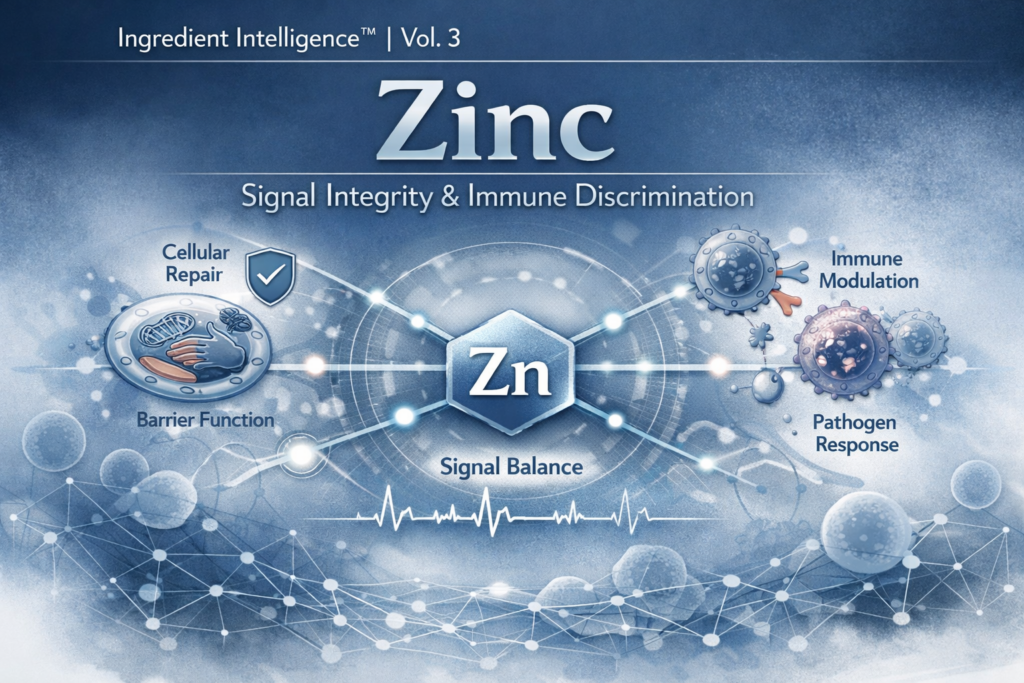
Zinc is often described as an “immune booster.”
That framing explains why zinc is frequently misunderstood — and frequently misused.
Zinc does not push physiology forward.
It calibrates how systems respond.
From a systems homeostasis perspective, zinc functions as a regulator of signal integrity. It sits at the intersection of immune signaling, tissue repair, transcriptional control, and barrier function — not to amplify responses, but to ensure they are appropriate, proportional, and resolvable.
When zinc availability is sufficient, communication between systems is clear. When it is not, signaling becomes noisy, exaggerated, or poorly coordinated.
What Zinc Insufficiency Looks Like Systemically
Zinc insufficiency rarely presents as a single, obvious deficiency. Instead, it often appears as patterns of reduced tolerance:
- slower tissue repair
- impaired barrier integrity
- blunted or dysregulated immune responses
- reduced resilience under physiological stress
These patterns reflect loss of coordination, not lack of force.
The Hidden Trade-Off
Because zinc supports immune and repair pathways, it is often assumed that more zinc equals better protection. In practice, chronic zinc loading can distort signaling balance, interfere with complementary mineral systems, and reduce long-term resilience.
Zinc does not reward excess.
It rewards precision and context.
Zinc Through a Systems Homeostasis Lens
Within systems homeostasis, zinc acts as a boundary regulator — helping determine:
- when immune activation is appropriate
- when repair should proceed
- when signaling should resolve
In low-reserve systems, zinc mismanagement can amplify fragility rather than restore resilience. Its value depends entirely on energetic context, inflammatory load, and recovery capacity.
Closing Principle
Zinc strengthens systems not by pushing them harder, but by helping them respond appropriately.
When resilience is the goal, signal integrity matters more than stimulation.

Clinical & Professional Context
This systems-based framework reflects the same approach used in both clinical practice and professional consulting.
Clinical services: OptimumHealthConsulting.com
OptimumHealthConsulting.com
If you’re a clinic, practitioner, or company interested in formulation strategy or systems-based ingredient design:
Formulation & professional consulting:
HealthspanFormulations.com