Preservatives, Biology, and the Hidden Cost of Modern Convenience
Preservatives are one of the great conveniences of modern life.
They allow food to travel farther, last longer, and remain visually appealing weeks or months after production. From a supply-chain perspective, they solve real problems.
From a biological perspective, however, preservatives are not neutral.
They are chemical inputs that interact with living systems — particularly the gut, immune system, and cellular energy machinery. And when exposure is frequent, layered, and begins early in life, those interactions matter.
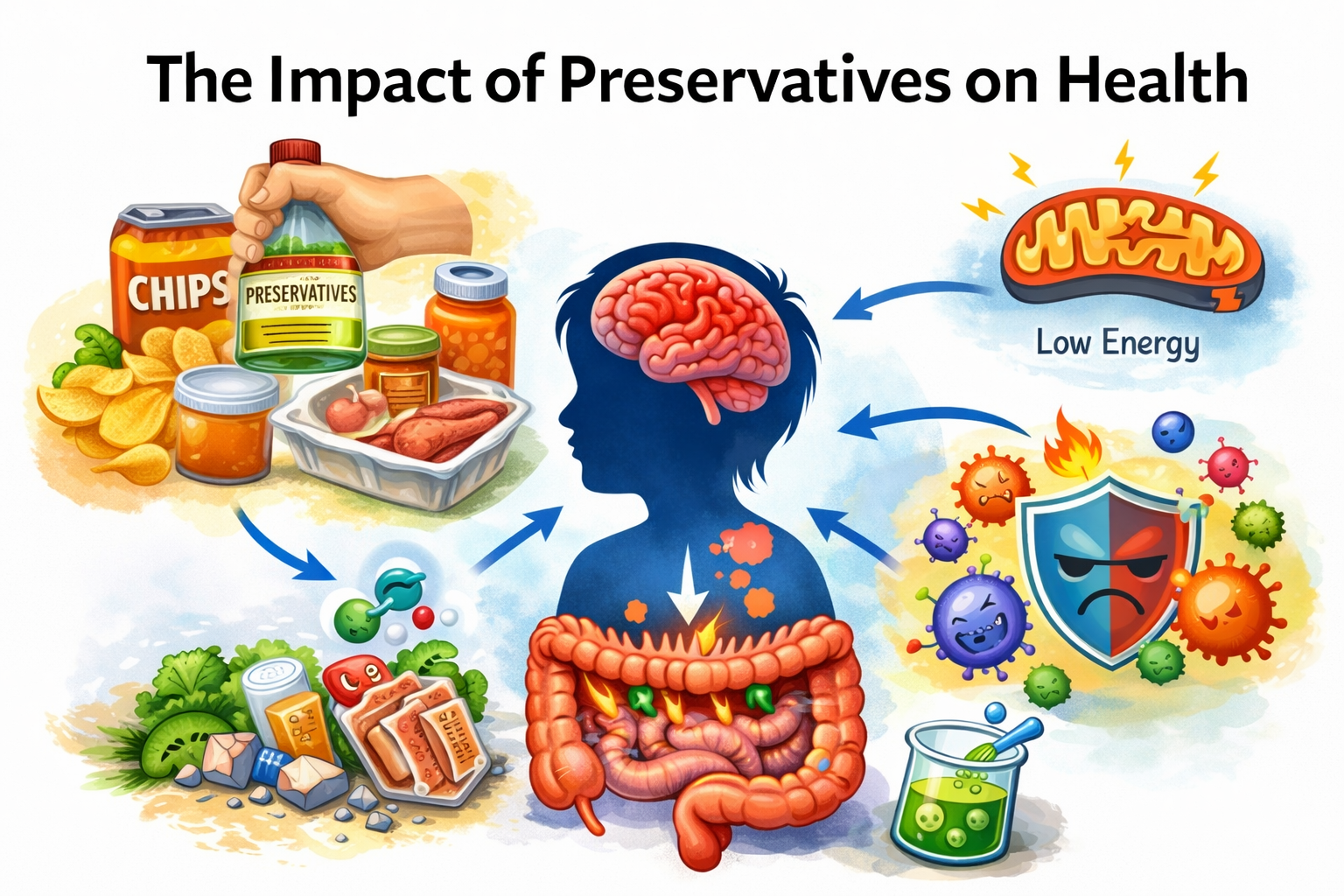
The image above illustrates a systems-based reality that is increasingly difficult to ignore.
Preservatives Don’t Act in Isolation
Most discussions about preservatives focus on individual safety thresholds:
“Is this ingredient approved?”
“Is it below the allowable daily intake?”
Those questions are necessary — but insufficient.
Biology doesn’t experience ingredients one at a time.
It experiences total exposure.
Children today are exposed to preservatives across:
- Packaged foods and snacks
- Beverages
- Condiments and sauces
- Medications
- Supplements
Each exposure may be small. The cumulative biological load is not.
The Gut: First Contact, First Consequence
The gastrointestinal tract is the primary interface between preservatives and the body.
Many preservatives are antimicrobial by design. While this helps prevent spoilage, it also means they can influence the gut ecosystem — especially with repeated exposure.
Even subtle shifts in gut ecology can affect:
- Microbial diversity
- Barrier integrity
- Neurotransmitter production
- Immune signaling
In developing children, where the gut–immune–brain axis is still maturing, these effects may be amplified.
Immune Activation Has a Metabolic Price
When the gut environment changes, the immune system responds.
Not always dramatically. Often quietly.
Low-grade immune activation still requires energy. It still requires resources. And it still competes with other biological priorities such as growth, repair, learning, and emotional regulation.
This is one reason symptoms that appear unrelated — fatigue, irritability, poor recovery, reduced resilience — often share a common underlying theme: energetic strain.
Mitochondria: The Overlooked Middle Layer
Mitochondria sit at the crossroads of:
- Detoxification
- Immune function
- Neurological performance
- Metabolic flexibility
When exposure load increases, mitochondrial efficiency can decrease — not catastrophically, but incrementally.
The result isn’t acute illness.
It’s reduced physiological margin.
Less buffer.
Less adaptability.
Less resilience.
Over time, that matters.
This Is Not About Fear — It’s About Formulation
This conversation is often mischaracterized as alarmist or anti-modern.
It shouldn’t be.
Preservatives are not inherently “bad.”
But they are biologically active.
And that means formulation choices matter.
The question is no longer:
“Can we use preservatives?”
It’s:
“Which ones, at what levels, in what combinations, and for whom?”
A developing child is not a scaled-down adult.
A chronically stressed system is not a resilient one.
A formulation optimized for shelf life is not automatically optimized for biology.
Why This Matters Beyond Food
This discussion extends well beyond packaged snacks.
It applies equally to:
- Functional beverages
- Nutritional supplements
- Pediatric formulations
- Clinical nutrition products
Ironically, many products designed to “support health” still rely on preservative strategies that increase biological load elsewhere.
That contradiction is becoming harder to justify.
A Systems Lens Changes the Conversation
When we view health through a systems lens, several things become clear:
- No single ingredient explains complex outcomes
- Cumulative exposure matters more than isolated thresholds
- Energy availability is a limiting factor in resilience
- Formulation is a biological decision, not just a technical one
This perspective doesn’t demand perfection.
It demands intentionality.
The Opportunity Ahead
As clinicians, formulators, and health innovators, we have an opportunity to do better — not by eliminating modern tools, but by using them more intelligently.
That means:
- Reducing unnecessary additives where possible
- Choosing preservative strategies with lower biological cost
- Designing products that support, rather than tax, human systems
Convenience doesn’t have to come at the expense of resilience.
But biology always keeps the score.
#SystemsBiology #FunctionalNutrition #GutBrainAxis #MitochondrialHealth #ProductFormulation #Healthspan #RobLamberton #RobertLamberton