Mast Cell Activation Syndrome (MCAS)
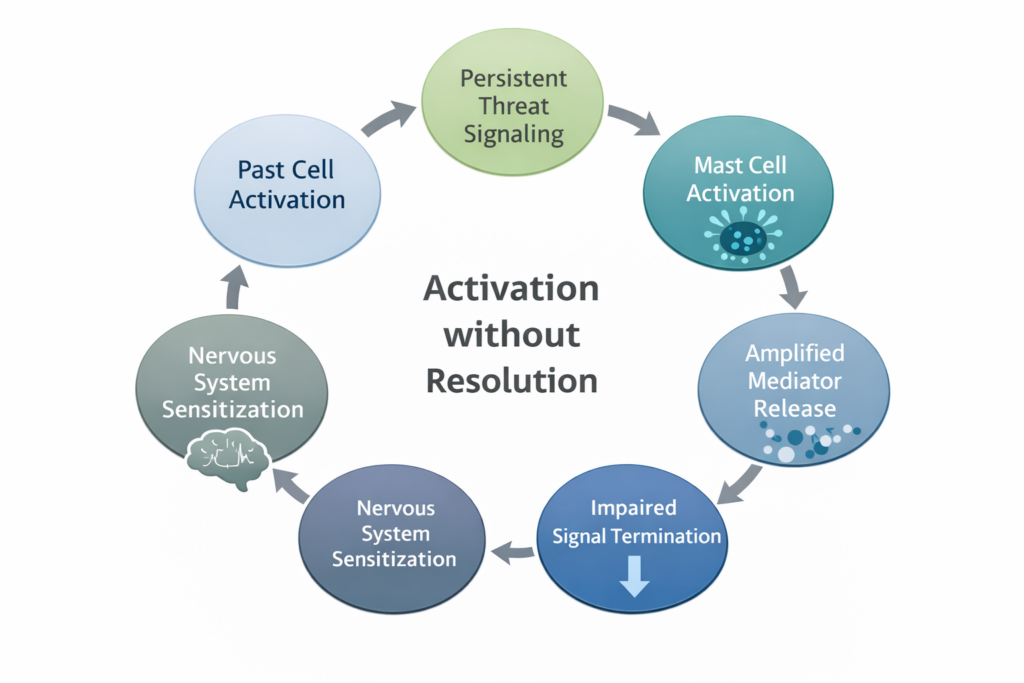
When Activation Persists Without Resolution
Systems Homeostasis Perspective
This article examines mast cell activation through a systems homeostasis lens, emphasizing signal resolution, regulatory control, and clinical restraint.
Mast cell activation is a normal immune process.
Mast Cell Activation Syndrome represents something different: a failure of signal termination.
This distinction matters.
Activation vs Dysregulation
Mast cells are designed to respond to threat and then return to baseline. In MCAS, activation becomes persistent, amplified, and poorly regulated—often independent of the original trigger.
This does not mean mast cells are broken. It means the system has lost its ability to resolve signaling.
⏩ How MCAS Differs From Histamine Intolerance
Histamine intolerance reflects a mismatch between load and degradation capacity
MCAS reflects ongoing activation even when load is reduced
In MCAS, mast cells respond not only to antigens, but to neuro-immune signaling, endothelial stress, and metabolic strain.
This explains why MCAS presentations are multi-systemic, unpredictable, and poorly explained by food lists alone.
The Risk of Over-Diagnosis
Labeling reactive patients as having MCAS prematurely can freeze clinical reasoning, discourage recovery expectations, and promote lifelong suppression strategies.
MCAS is real—but it is not common, and it should not be the default explanation for histamine reactivity.
A Systems-Based Clinical Perspective
In many cases, mast cell behavior improves when:
⏩ barrier integrity is restored
⏩ immune load decreases
⏩ nervous system tone stabilizes
⏩ metabolic capacity improves
When activation persists despite these corrections, MCAS deserves careful evaluation—not reflex labeling.
Ethical Framing Matters
Not all activation is pathology.
Not all persistence is permanent.
Clinical precision requires both caution and restraint.
Systems Reminder
Persistent activation reflects failure of resolution—not necessarily irreversible disease.
✴️ How I Work
I work from a systems physiology perspective, looking at how environmental signals, nutrition, stress, digestion, and recovery interact to shape adaptive capacity—rather than chasing isolated symptoms.
✴️ Work With Me
⏩ Clinical Consulting:
⏩ Formulation & Product Development:
HealthspanFormulations.com