Ingredient Intelligence™ Vol 5: Essential Amino Acids
Substrate Availability, Signalling Fidelity, and Systems Throughput
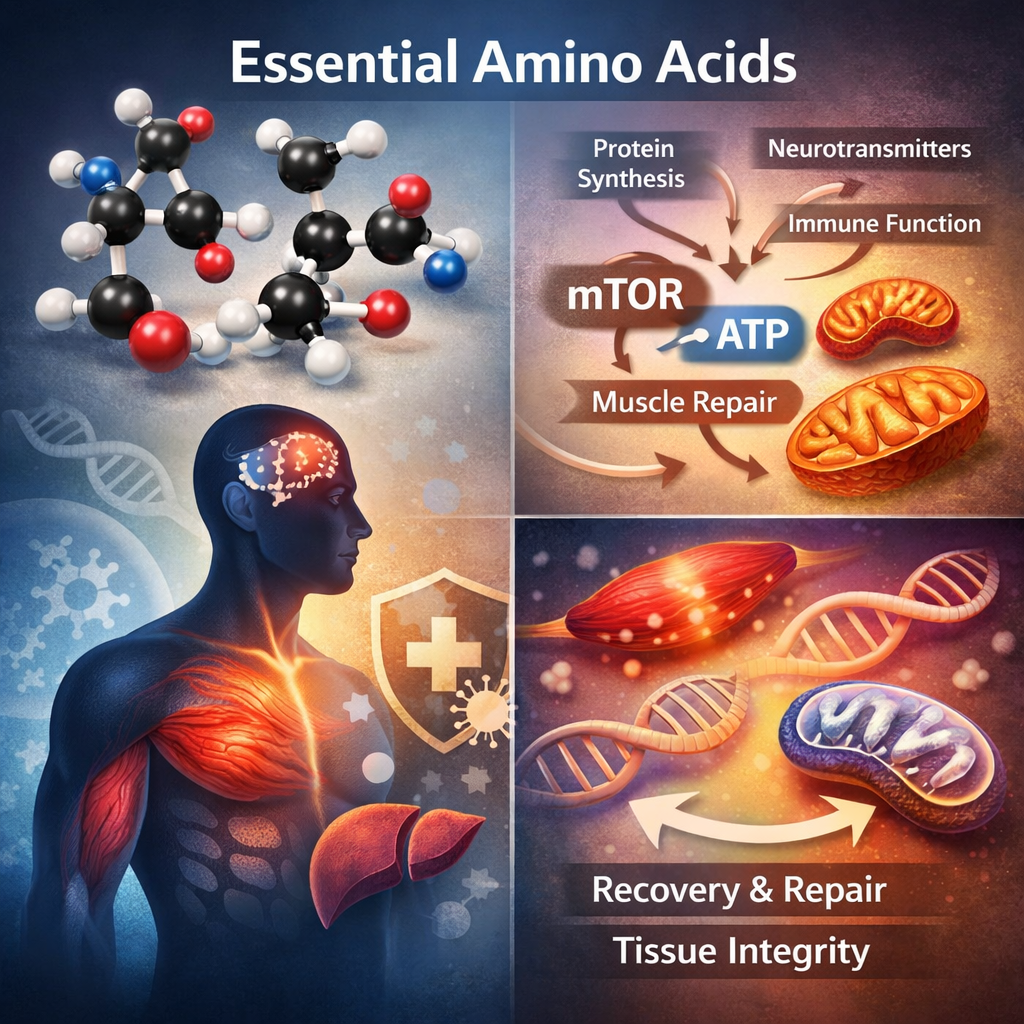
Essential amino acids (EAAs) are often discussed in the context of muscle growth or athletic performance. From a systems homeostasis perspective, this framing is incomplete and frequently misleading.
EAAs are not performance agents.
They are foundational substrates that determine whether the body can maintain structure, complete repair, and sustain adaptive capacity.
They do not initiate change.
They determine whether change can finish.
Essential Amino Acids as a Systems Constraint
A biological system cannot express resilience without material availability.
In states of:
- chronic psychological or physiological stress
- aging
- illness or recovery
- inflammatory load
- under-eating
- impaired digestion
- metabolic rigidity
…the primary limitation is often not signalling, motivation, or hormonal drive. It is substrate access.
Tissue repair, enzyme production, immune turnover, neurotransmitter synthesis, and mitochondrial protein renewal all require essential amino acids. When availability is insufficient, the system compensates by reallocating internal resources — most commonly through tissue breakdown.
This is not a deficiency model.
It is a capacity erosion model.
Protein Intake Is Not the Same as Amino Acid Availability
Whole protein intake is frequently assumed to equal amino acid sufficiency. Physiologically, this assumption often fails.
Whole proteins require:
- adequate gastric acid
- sufficient protease activity
- intact intestinal absorption
- hepatic processing capacity
In many individuals — particularly those under stress, aging, inflamed, or ill — these steps are rate-limiting.
EAAs reduce friction in the system:
- minimal digestive burden
- predictable absorption
- direct availability for synthesis and repair
From a systems standpoint, EAAs function as low-complexity building inputs when upstream access is constrained.
This is not optimization.
It is structural triage.
Signalling Without Substrate Is Unproductive
Modern health culture places enormous emphasis on signalling:
- training stimuli
- metabolic stress
- hormonal cues
- pathway activation (mTOR, AMPK, etc.)
Signalling without substrate does not produce adaptation.
It produces incomplete work.
Without adequate EAAs:
- training becomes catabolic
- recovery stalls
- immune turnover slows
- detoxification pathways falter
- structural integrity declines
This is why individuals can be “doing everything right” and still deteriorate.
The signal is present.
The materials are not.
Aging, Illness, and Amino Acid Economics
With aging, several predictable shifts occur:
- reduced appetite
- impaired digestion
- anabolic resistance
- increased inflammatory tone
- slower protein turnover
In illness and recovery states:
- amino acid demand increases
- immune and tissue turnover accelerates
- tolerance for large protein loads often declines
In these contexts, EAAs may function as:
- anti-catabolic support
- repair permission
- structural insurance
Not to build more — but to lose less.
This distinction is critical.
EAAs and Metabolic Flexibility
EAAs sit downstream of metabolic flexibility.
They do not force adaptation.
They allow adaptation to complete once the system is ready.
In flexible systems, EAAs support recovery and rebuilding.
In constrained systems, they may reduce tissue loss — but they cannot override poor sequencing.
They are supportive substrates, not corrective interventions.
What EAAs Do Not Fix
From a systems homeostasis perspective, EAAs do not:
- repair digestive dysfunction
- override stress dominance
- correct sleep disruption
- compensate for inflammatory overload
- replace whole-food nutrition
- resolve sequencing errors
Used incorrectly, EAAs delay recognition of deeper constraints.
Used correctly, they preserve capacity so recovery can proceed without additional burden.
Systems Takeaway
Essential amino acids are not about enhancement.
They are about structural permission.
They determine whether the system can:
- repair
- adapt
- maintain
- or must cannibalize itself to survive
This is why EAAs belong exactly where they sit in the Ingredient Intelligence™ sequence:
after digestive capacity
after metabolic flexibility
as substrates for rebuilding — not signalling
Ingredient Intelligence™ Summary
- EAAs are substrates, not stimulants
- They support completion of repair, not initiation
- Their value increases as digestive and adaptive reserve decline
- They cannot compensate for poor sequencing
- Properly used, they preserve systems capacity
Formulation & Product Development
If you are a clinic, practitioner, or company developing nutritional supplements, amino acid formulations, or functional products, I provide formulation strategy and product development grounded in systems physiology and real-world clinical application.
 HealthspanFormulations.com
Clinical Consulting
For individuals and practitioners seeking clinical consulting rooted in systems homeostasis, metabolic regulation, and adaptive capacity — not symptom chasing, my clinical services are available at:
OptimumHealthConsulting.com
#IngredientIntelligence
#SystemsHomeostasis
#ClinicalNutrition
#AminoAcids
#ProductFormulation
#NutraceuticalInnovation
#FunctionalMedicine
#RobLamberton
#RobertLamberton