Ingredient Intelligence™ Digestive Capacity: Hydrochloric Acid, Enzymes, and the Catabolic Stress State
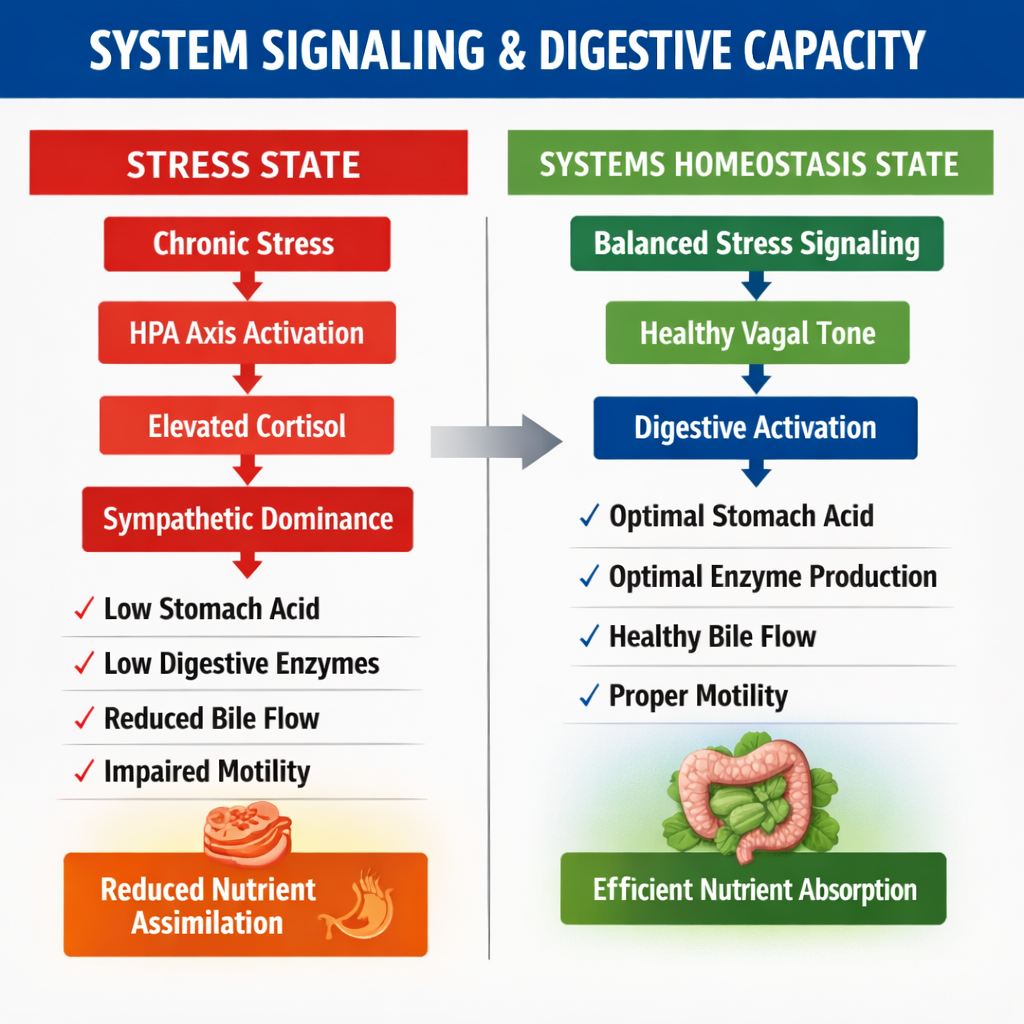
1. The common misunderstanding
Digestive dysfunction is commonly interpreted as a problem of insufficient stomach acid or digestive enzymes.
This interpretation leads naturally to supplementation.
But digestion is not simply a biochemical process.
It is a regulated physiological function governed by system signaling.
2. The stress-response signaling shift
When the body experiences chronic stress, the Hypothalamic–Pituitary–Adrenal Axis becomes persistently activated.
This produces sustained Cortisol signaling.
From a systems perspective, this represents a shift toward catabolic survival physiology.
The body prioritizes:
Energy mobilization
Glucose availability
Rapid response to threat
Digestive processes become secondary.
3. Why digestion shuts down
Digestive function relies heavily on parasympathetic signaling through the vagus nerve.
This signaling regulates:
Hydrochloric acid secretion
Pancreatic enzyme release
Bile flow
Gut motility
Nutrient absorption
But chronic stress produces sympathetic nervous system dominance.
The signalling cascade becomes:
Chronic Stress
↓
HPA Axis Activation
↓
Elevated Cortisol
↓
Sympathetic Dominance
↓
Reduced Vagal Digestive Signaling
↓
Reduced Digestive Capacity
In this environment, the digestive organs themselves are often structurally normal.
What has changed is the regulatory signaling environment.
4. The systems homeostasis perspective
From the perspective of Systems Homeostasis, digestive dysfunction is often downstream of broader regulatory imbalance.
Persistent stress signaling shifts physiology toward a catabolic state in which:
Repair is deprioritized
Nutrient assimilation declines
Structural maintenance is reduced
The digestive system is responding appropriately to the signals it receives.
5. Implications for intervention
Supplemental digestive enzymes or hydrochloric acid can sometimes provide short-term support.
But when the underlying signaling environment remains dominated by chronic stress physiology, these interventions may only partially restore digestive capacity.
Supporting digestion therefore often requires addressing the regulatory systems that govern digestive signaling, including:
Circadian rhythm regulation
Nervous system balance
Metabolic stability
Stress physiology
When the signaling environment shifts back toward parasympathetic regulation, digestive capacity frequently improves.
6. The key takeaway
Digestive dysfunction is not always a failure of digestive chemistry.
It is often a reflection of system signaling priorities.
When the body remains in a chronic catabolic stress state, digestion becomes secondary to survival.
Restoring digestive capacity therefore involves restoring the conditions of physiological regulation that allow the digestive system to function normally.
“This article is part of the Ingredient Intelligence™ series exploring how nutrients and compounds interact with physiological signaling and systems regulation.”
✴️ Work With Me
If you are developing nutritional supplements, botanicals, or functional beverages, I provide formulation strategy grounded in systems physiology and real-world clinical application.
HealthspanFormulations.com
For individuals and practitioners seeking clinical consulting rooted in systems homeostasis, metabolic regulation and adaptive capacity – not symptom chasing – my clinical services are available at: