Glycine — From “Simple” Amino Acid to System Stabilizer
Ingredient Intelligence™ Vol. 4.75
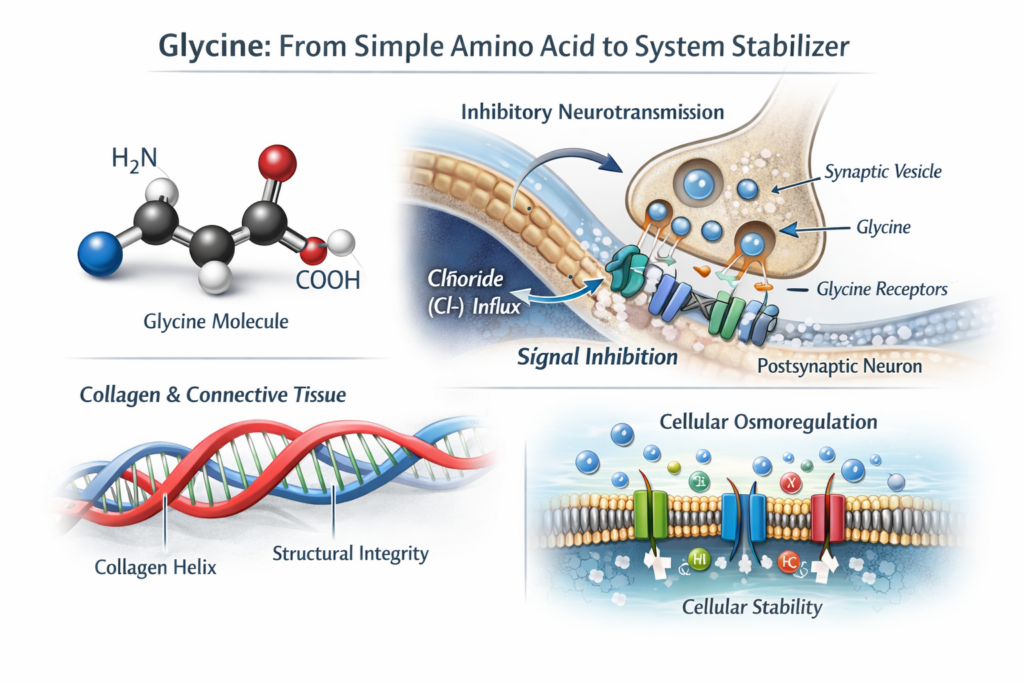
Glycine is often dismissed as a minor, non-essential amino acid—something structural, supportive, and unremarkable. That view misses its real role.
From a systems homeostasis perspective, glycine is less about “doing more” and more about allowing systems to settle, integrate, and resolve signals appropriately.
Glycine as a Signalling Modulator
Physiology is governed not just by excitatory signals, but by the ability to contain and resolve them. Glycine functions as an inhibitory co-signal across multiple systems, helping define thresholds rather than pushing outcomes.
In the nervous system, glycine contributes to inhibitory tone, shaping how signals are interpreted rather than amplified. This matters because many modern stress patterns are not driven by a lack of stimulation, but by impaired signal dampening.
More excitation is rarely the answer when tolerance is already narrow.
Structural Roles That Influence Signalling
Glycine is a major constituent of collagen and connective tissue. This is not merely structural trivia. Tissue integrity influences circulation, mechanotransduction, and intercellular communication. When structure is compromised, signalling becomes distorted—often louder, more inflammatory, and less precise.
By supporting connective tissue integrity, glycine indirectly supports signal clarity and delivery, not by force, but by maintaining the medium through which signals move.
Osmoregulation, Cellular Calm, and Recovery
At the cellular level, glycine participates in osmotic balance and cytoprotective processes. These functions help cells maintain volume, membrane stability, and internal order under stress.
In systems terms, this is containment—the ability to remain coherent under load.
Containment precedes adaptation. Without it, signalling becomes chaotic and recovery stalls.
Why Glycine Matters in a Signalling-Saturated World
Many individuals today live in a state of persistent signalling pressure: metabolic, inflammatory, neurological, and psychological. In this context, adding more “drivers” often backfires.
Glycine represents the opposite philosophy:
- not escalation
- not optimization
- but restoration of signal boundaries
It supports the system’s ability to decide appropriately, rather than react indiscriminately.
A Systems Takeaway
Glycine’s value is not that it stimulates change, but that it permits resolution.
From a systems homeostasis lens, resilience depends as much on inhibitory capacity as on activation. Systems fail not only when signals are too weak—but when they cannot be turned off.
Glycine reminds us that sometimes the most powerful intervention is the one that reduces noise, preserves tolerance, and allows physiology to return to baseline on its own terms.
Ingredient Intelligence™ is a systems-first series exploring how nutrients and compounds function as signals, not isolated fixes—always through the lens of context, capacity, and adaptive reserve.
Formulation & Systems Consulting
If you are a clinic, practitioner, or company developing nutritional supplements, botanicals, or functional products, I provide formulation strategy and development grounded in systems physiology and real-world clinical application.
 HealthspanFormulations.com
Clinical Consulting
For individuals and practitioners seeking clinical consulting rooted in systems homeostasis, metabolic regulation, and adaptive capacity—not symptom chasing—my clinical services are available at:
OptimumHealthConsulting.com
#IngredientIntelligence #SystemsHomeostasis #SignalIntegrity #AdaptiveCapacity #PhysiologicalResilience #AminoAcids #ClinicalReasoning #FormulationScience #FunctionalMedicine #NutraceuticalInnovation #RobLamberton #RobertLamberton