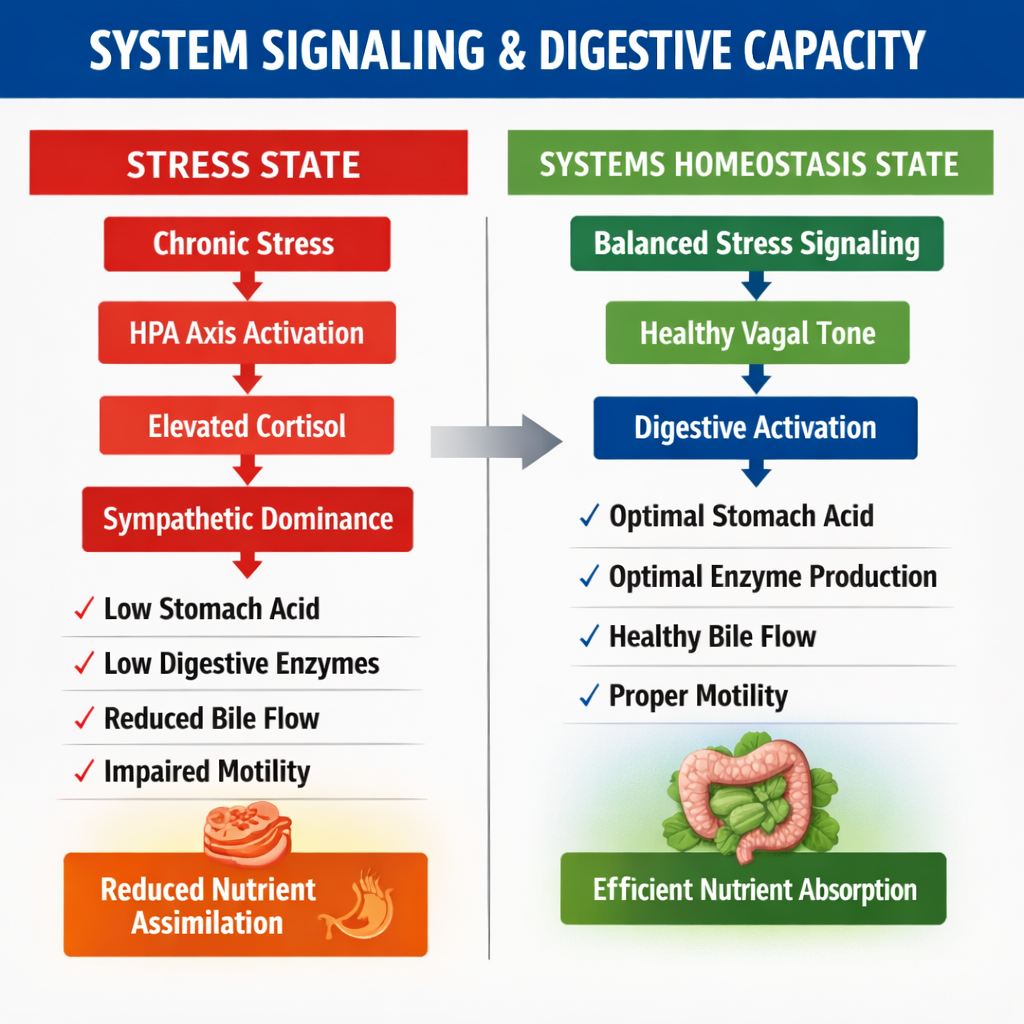
In this environment, the digestive organs themselves are often structurally normal.
What has changed is the regulatory signaling environment.
4. The systems homeostasis perspective
From the perspective of Systems Homeostasis, digestive dysfunction is often downstream of broader regulatory imbalance.
Persistent stress signaling shifts physiology toward a catabolic state in which:
Repair is deprioritized Nutrient assimilation declines Structural maintenance is reduced
The digestive system is responding appropriately to the signals it receives.
5. Implications for intervention
Supplemental digestive enzymes or hydrochloric acid can sometimes provide short-term support.
But when the underlying signaling environment remains dominated by chronic stress physiology, these interventions may only partially restore digestive capacity.
Supporting digestion therefore often requires addressing the regulatory systems that govern digestive signaling, including:
Circadian rhythm regulation Nervous system balance Metabolic stability Stress physiology
When the signaling environment shifts back toward parasympathetic regulation, digestive capacity frequently improves.
6. The key takeaway
Digestive dysfunction is not always a failure of digestive chemistry.
It is often a reflection of system signaling priorities.
When the body remains in a chronic catabolic stress state, digestion becomes secondary to survival.
Restoring digestive capacity therefore involves restoring the conditions of physiological regulation that allow the digestive system to function normally.
“This article is part of the Ingredient Intelligence™ series exploring how nutrients and compounds interact with physiological signaling and systems regulation.”
✴️ Work With Me
If you are developing nutritional supplements, botanicals, or functional beverages, I provide formulation strategy grounded in systems physiology and real-world clinical application.
For individuals and practitioners seeking clinical consulting rooted in systems homeostasis, metabolic regulation and adaptive capacity – not symptom chasing – my clinical services are available at:
Each week the nutritional supplement and functional beverage industry provides a snapshot of where consumer demand, ingredient innovation, and product formulation are heading.
The signals emerging this week point toward one clear theme:
The convergence of metabolic health, convenience, and functional delivery systems.
The line between supplements, beverages, and everyday foods continues to blur.
Here are the developments worth paying attention to.
1. Gut Health Continues to Dominate Innovation
Gut health remains one of the most active innovation spaces in the supplement industry.
Recent product launches and formulation strategies increasingly target the gut–brain axis, linking digestive health to mood, cognition, and metabolic regulation.
Brands launching new microbiome-focused formulations include companies such as Daily Nouri, O Positiv, and Cymbiotika, each emphasizing combinations of:
Prebiotic fibers
Next-generation probiotics
Postbiotics
Gut-supporting amino acids such as L-glutamine
Rather than simple digestive products, these formulations are now positioned as system-wide metabolic and neurological support tools.
For formulators, this trend reinforces an important shift: microbiome support is no longer a niche digestive category—it is becoming a central platform for multiple health claims.
2. Creatine Expands Beyond Sports Nutrition
Creatine continues to move rapidly beyond its traditional bodybuilding audience.
Increasingly, creatine is being positioned for:
Cognitive performance
Women’s health
Healthy aging
General metabolic support
Market projections suggest the global creatine market could reach approximately $4.2 billion by 2030, reflecting its growing acceptance as a general wellness compound rather than a purely athletic supplement.
One notable shift is the rapid expansion of consumer-friendly formats, including gummies, sachets, and functional beverage integrations.
For product developers, creatine now represents one of the few ingredients with strong clinical credibility that can be repositioned across multiple categories.
3. Healthy Aging Ingredients Continue Their Rise
Several ingredients associated with longevity and cellular metabolism continue gaining momentum in the supplement industry.
Among the most discussed in current product development pipelines:
NMN and NAD-related compounds
Shilajit
Sea moss
Companies such as Layn Natural Ingredients are expanding the NAD pathway category, preparing high-purity NAD ingredients alongside their existing NMN offerings.
This reflects a broader industry movement toward healthy aging formulations that target mitochondrial health, metabolic resilience, and cellular repair pathways.
Rather than single ingredients, many companies are now building multi-pathway longevity stacks.
4. Functional Beverages Move Beyond Hydration
Functional beverages continue evolving from simple hydration products into targeted health delivery systems.
Industry trend reports now describe this shift as “Beverages with Purpose.”
These drinks are increasingly formulated to support:
Energy and focus
Stress resilience
Immune health
Metabolic regulation
Gut health
Key ingredients currently driving beverage innovation include:
Adaptogens
Ashwagandha
Reishi
Nootropics
L-theanine
Lion’s mane mushroom
Microbiome support
Probiotics
Prebiotic fibers
At the same time, large beverage companies are entering the category with functional soda products, signaling that gut-health drinks may soon compete directly with traditional soft drinks.
5. Protein Innovation Responds to GLP-1 Demand
One of the most interesting formulation shifts is being driven by the rise of GLP-1 medications.
Consumers using these medications often require higher nutrient density in smaller volumes, which is influencing product development across both supplements and functional beverages.
Ingredient companies are responding.
For example, Roquette recently introduced NUTRALYS Pea 850F, a new pea protein isolate designed to solve one of the major challenges in plant protein products: off-flavor and bitterness.
Improved sensory profiles could significantly expand the use of plant proteins in:
Ready-to-drink protein beverages
Functional meal replacements
High-protein snack foods
6. Stress and Cortisol Support Products Expand
Stress management formulations continue to see strong growth.
One product attracting attention ahead of Expo West 2026 is CAVU Nutrition’s ThymoQuin Cortisol Support, built around TriNutra’s standardized black seed extract.
Clinical research suggests this ingredient may support reductions in cortisol while improving sleep and mood markers.
This reflects the broader rise of what some analysts call the “Anxiety Economy,” where consumers increasingly seek nutritional solutions for stress resilience.
Common ingredients appearing in these products include:
Saffron extract
Adaptogenic botanicals
Probiotics
Polyphenol-rich extracts
7. Regulatory Pressure Is Increasing
While innovation continues at a rapid pace, the regulatory environment is tightening.
In the United States, the FDA is signaling increased scrutiny of self-GRAS ingredient designations and NDIN pathways.
This could raise the barrier to entry for smaller supplement brands relying on novel ingredients without robust safety documentation.
For the industry, this means that clinical evidence, regulatory compliance, and ingredient transparency will become increasingly important competitive advantages.
Final Thoughts
Taken together, this week’s developments highlight several structural trends shaping the future of nutritional products:
• Gut health is evolving into a multi-system metabolic platform • Creatine is transitioning into mainstream wellness and cognitive health • Functional beverages are becoming health delivery systems • GLP-1 medications are reshaping nutrient density requirements • Healthy aging ingredients are driving longevity-focused product design
For formulation scientists, practitioners, and product developers, the opportunity lies in designing products that combine clinical credibility, sensory performance, and consumer convenience.
The next generation of supplements and functional beverages will likely emerge at the intersection of those three forces.
Work With Me
If you are a clinic, practitioner, or company developing nutritional supplements, botanicals, or functional beverages, I provide formulation strategy and development grounded in systems physiology and real-world clinical application.
HealthspanFormulations.com
For individuals or practitioners seeking clinical consulting rooted in systems homeostasis and metabolic regulation:
Most nutrition conversations assume a simple equation:
what you consume = what your body uses.
But biology doesn’t work that way.
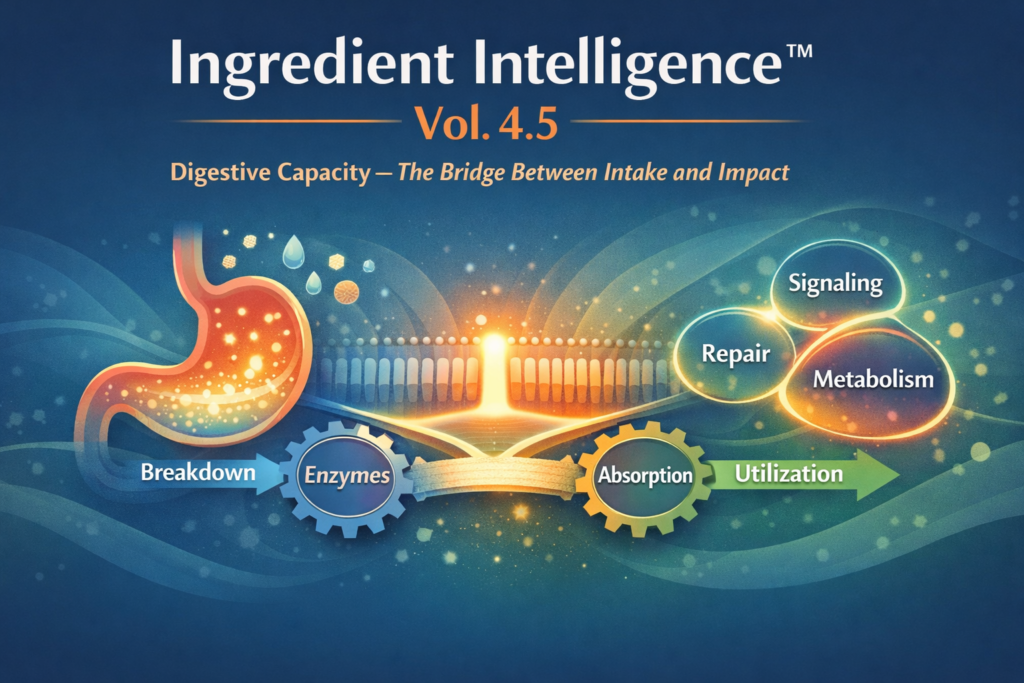
Between intake and impact sits a critical, often-overlooked system: digestive capacity.
Why Digestive Capacity Matters
Digestive capacity determines whether food and supplements ever become biologically available substrates. Without sufficient breakdown, signaling and absorption never fully occur — regardless of diet quality or supplement sophistication.
This is why two individuals can consume identical meals and experience radically different outcomes.
From a systems homeostasis perspective, digestion is not about symptoms like bloating or reflux. It is about throughput — the system’s ability to convert external inputs into usable internal signals and structures.
Hydrochloric Acid: The Gatekeeper Signal
Stomach acid is more than a digestive fluid. It is a coordination signal.
Adequate hydrochloric acid:
initiates protein denaturation
triggers downstream enzyme release
supports mineral ionization (iron, zinc, calcium, magnesium)
provides antimicrobial containment
signals appropriate gastric emptying
Low or inconsistent acid disrupts this entire cascade, increasing signal noise throughout the GI–immune–metabolic axis.
Digestive Enzymes: Throughput, Not Stimulation
Digestive enzymes do not “boost” digestion — they restore mechanical efficiency.
Their role is to:
complete macronutrient breakdown
reduce fermentable residue
lower immune activation from partially digested substrates
improve substrate availability for tissue repair and energy production
In systems terms, enzymes reduce processing friction, allowing digestion to occur with less compensatory stress.
If you are a clinic, practitioner, or company developing nutritional supplements, botanicals, or functional products, I provide formulation strategy and development grounded in systems physiology and real-world clinical application.
HealthspanFormulations.com
Clinical Consulting
For individuals and practitioners seeking clinical consulting rooted in systems homeostasis, metabolic regulation, and adaptive capacity — not symptom chasing — my clinical services are available at:
That framing explains why zinc is frequently misunderstood — and frequently misused.
Zinc does not push physiology forward.
It calibrates how systems respond.
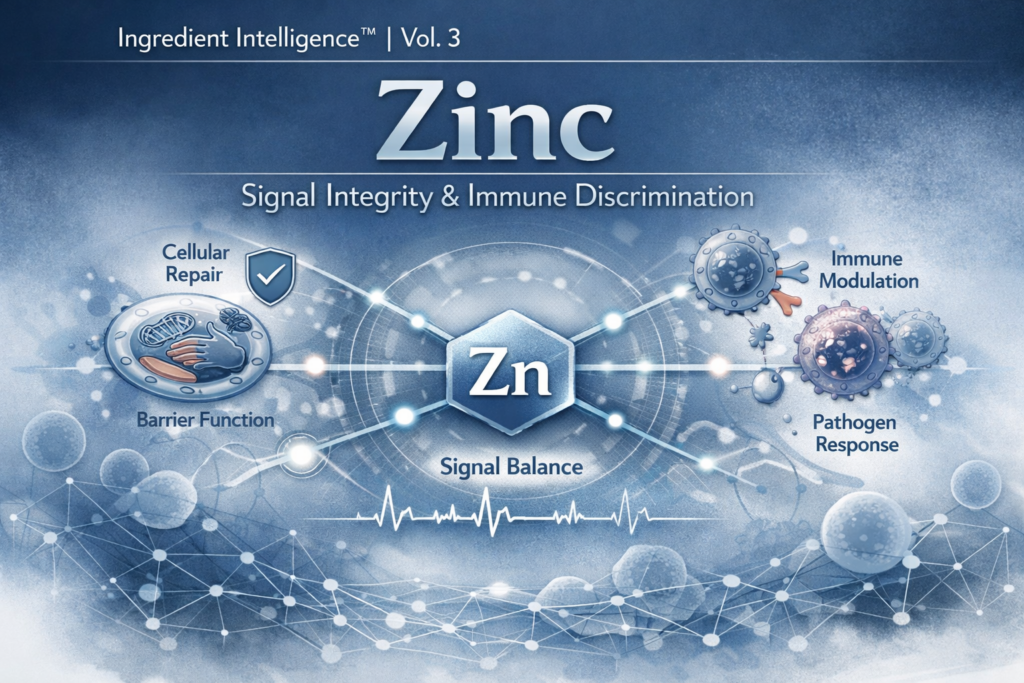
From a systems homeostasis perspective, zinc functions as a regulator of signal integrity. It sits at the intersection of immune signaling, tissue repair, transcriptional control, and barrier function — not to amplify responses, but to ensure they are appropriate, proportional, and resolvable.
When zinc availability is sufficient, communication between systems is clear. When it is not, signaling becomes noisy, exaggerated, or poorly coordinated.
What Zinc Insufficiency Looks Like Systemically
Zinc insufficiency rarely presents as a single, obvious deficiency. Instead, it often appears as patterns of reduced tolerance:
slower tissue repair
impaired barrier integrity
blunted or dysregulated immune responses
reduced resilience under physiological stress
These patterns reflect loss of coordination, not lack of force.
The Hidden Trade-Off
Because zinc supports immune and repair pathways, it is often assumed that more zinc equals better protection. In practice, chronic zinc loading can distort signaling balance, interfere with complementary mineral systems, and reduce long-term resilience.
Zinc does not reward excess.
It rewards precision and context.
Zinc Through a Systems Homeostasis Lens
Within systems homeostasis, zinc acts as a boundary regulator — helping determine:
when immune activation is appropriate
when repair should proceed
when signaling should resolve
In low-reserve systems, zinc mismanagement can amplify fragility rather than restore resilience. Its value depends entirely on energetic context, inflammatory load, and recovery capacity.
Closing Principle
Zinc strengthens systems not by pushing them harder, but by helping them respond appropriately.
When resilience is the goal, signal integrity matters more than stimulation.
Clinical & Professional Context
This systems-based framework reflects the same approach used in both clinical practice and professional consulting.
Clinical services: OptimumHealthConsulting.com
OptimumHealthConsulting.com
If you’re a clinic, practitioner, or company interested in formulation strategy or systems-based ingredient design:
Vitamin D has long been associated with bone density, immune balance, and calcium metabolism. Yet emerging research suggests its influence may extend much further—into the cellular mechanisms that govern how we age.
A newly published analysis from the VITAL trial, one of the most robust long-term randomized trials of nutrient supplementation to date, adds an important piece to the longevity conversation. The findings suggest that consistent Vitamin D₃ supplementation modestly but significantly preserved leukocyte telomere length over four years in older adults, compared with placebo.
This does not mean Vitamin D “stops aging.” But it does suggest that maintaining adequate Vitamin D status may help slow one measurable contributor to biological aging, particularly under conditions of metabolic and immune stress.
Telomeres: One Window Into Biological Aging
Telomeres are the protective caps at the ends of chromosomes. Each time a cell divides, telomeres shorten slightly. Over time, excessive shortening is associated with cellular senescence, impaired tissue repair, and increased disease vulnerability.
Telomere length is not destiny, nor is it the sole marker of aging. But it is a useful proxy for cumulative cellular stress—oxidative, inflammatory, immune, and metabolic.
In the VITAL sub-study, participants receiving Vitamin D₃ (2,000 IU/day) experienced significantly less telomere shortening than those receiving placebo. Omega-3 fatty acids, notably, did not show the same effect in this analysis.
The magnitude of benefit was described as modest but statistically significant, which is exactly what we expect from nutritional interventions that support physiology rather than override it.
Why Vitamin D May Matter in a Metabolic Chaos™ Context
From a functional and Metabolic Chaos™ lens, aging is not driven by a single “root cause,” but by interacting stressors that accumulate over time:
Immune dysregulation
Chronic low-grade inflammation
Mitochondrial inefficiency
Impaired DNA repair
Circadian disruption
Reduced hormonal signaling resilience
Vitamin D intersects with many of these systems simultaneously:
Immune modulation (innate and adaptive balance)
Inflammation signaling control
Mitochondrial gene expression
Genomic stability and DNA replication fidelity
Calcium signaling beyond bone tissue
Rather than acting as an anti-aging “switch,” Vitamin D appears to function more like a system stabilizer—helping cells respond more appropriately to ongoing stress.
In other words, it may help reduce the rate at which Metabolic Chaos accumulates.
No Megadoses, No Biohacking Extremes
One of the most important aspects of the VITAL findings is what wasn’t used:
No megadoses
No aggressive protocols
No pharmacologic intervention
Participants followed consistent, physiologic dosing over years—not weeks—and still demonstrated measurable benefit.
This reinforces a critical principle in functional and nutritional medicine:
Longevity support is often about consistency, sufficiency, and system support—not intensity.
Who Is Most Likely to Benefit?
Vitamin D insufficiency remains common, particularly in individuals who:
Spend most of their time indoors
Live at northern or southern latitudes
Have darker skin pigmentation
Experience chronic stress or immune activation
Carry higher body fat percentages
In clinical and practitioner settings, Vitamin D status often correlates with immune load, inflammatory tone, and recovery capacity rather than symptoms alone.
This is why testing—not guessing—is essential.
Practical Considerations (General Education Only)
Always assess serum 25-hydroxyvitamin D levels before long-term supplementation
Many adults fall into a maintenance range with 2,000–4,000 IU/day, though individual needs vary
Vitamin D works synergistically with Vitamin K₂, magnesium, and adequate dietary fat
Sun exposure, lifestyle stress, sleep, and gut absorption all influence outcomes
Vitamin D should be viewed as one contributor within a broader systems strategy, not a stand-alone solution.
Aging Is Not Just About Time
Chronological aging is inevitable. Biological aging is variable.
Cellular resilience, repair capacity, and immune balance determine how well we adapt to stress over time. Vitamin D appears to support these processes quietly, incrementally, and safely when used appropriately.
Not a miracle. Not a cure. But potentially a meaningful support lever for long-term cellular health.
Scientific Reference
Zhu H, et al. Vitamin D₃ supplementation, but not omega-3 fatty acids, preserves leukocyte telomere length over 4 years in older adults: results from the VITamin D and OmegA-3 TriaL (VITAL).The American Journal of Clinical Nutrition. 2025;121(6):1720-1731. Findings demonstrate modest but statistically significant benefits and warrant further replication.
Work With Me
I work with clinics, practitioners, and health-focused companies to design evidence-aligned nutritional supplement and functional drink formulations, and to help individuals understand how multiple physiological contributors interact over time.