Category: Digestion / Gut Health

A recent diet “fad”? – craze has been the increasing popularity of the Carnivore Diet.
I think the reaction of most practitioners like myself who work with patients and provide them with guidance on personalized diets is that the Carnivore Diet is probably extreme and potentially unhealthy. I think most individuals think of plant materials as inherently healthy: vegetables and some fruit content are considered to be part of a healthy diet. The fact does remain however that plants incorporate into their make up anti-nutrients which are designed to help prevent animals from eating them. Giving the GI tract a temporary break from exposure to antinutrients can be very beneficial to some individuals who are dealing with GI inflammation, leaky gut and related conditions.
And this seems to be one of the potential benefits of the Carnivore Diet, and it may in fact prove to be a temporary dietary intervention worth considering for individuals dealing with some of the mentioned GI issues.
This is probably also the case with the Ketogenic Diet: there is still some question as to whether long term adoption of the Low Carb / High Fat diet is beneficial: I think what is key with this type of diet is transitioning into keto adaptation so that one’s metabolism is metabolically flexible so it can easily transition between utilizing the sugar as well as the fat – ketone energy burning pathways.
One of the best sources for patient education about the Low Carb / High Fat (Ketogenic) Diet is the website: DietDoctor.com.
Following is a well balanced – and referenced article on the Carnivore Diet from DietDoctor.com.
One of the key issues regarding the Carnivore Diet at this point in time is the fact that there is very little published research on the topic.
Key considerations / takeaways from my perspective include the following:
– organ meats should be included in any diet as part of a healthy diet- deficiencies such as folate and other micronutrients may result from the long term adoption of the Carnivore Diet- there is some question as to what changes might occur in the microbiome by adopting this type of diet- not all people achieve complete success on a low-carb, high-fat ketogenic diet that is rich in vegetables- anecdotal evidence suggests that the Carnivore Diet may be beneficial in reversing or improving challenging health issues such as Rheumatoid Arthritis, depression, migraines and others- “there is no clear scientific proof” that we need to eat vegetables at all- Dr. Steve Phinney is concerned about potential electrolyte deficiencies in sodium, magnesium and potassium in the carnivore diet


Sinking our teeth into the carnivore diet:what’s known, what’s not


1. Why explore carnivore eating?

2. What to eat

3. Potential benefits

4. Experts weigh in

5. Testimonials and advocates

6. Ancient past

7. Paleomedicina in Hungary

8. Intestinal permeability

9. Colon cancer?

10. My one-month trial
Read More:

https://www.dropbox.com/s/po1ggolimjjq8ej/What%27s%20With%20the%20Carnivore%20Diet.docx?dl=0

More alarming news about glyphosate, a key component in Monsanto’s herbicide Roundup: its effects may harm several future generations beyond the individual exposed to it

“A new study published today finds a variety of adverse health impacts in second and third generation offspring of rats exposed to glyphosate. It is the first of its kind to look at transgenerational effects and shows how descendants of exposed offspring were more likely to develop prostate, kidney and ovarian diseases, obesity and birth abnormalities [1].

The study suggests that risk assessments need to take into consideration the ability of chemicals to impact future generations through transgenerational effects, instead of only looking at the health impacts of direct exposure [2]”.

“This study provides alarming new evidence supporting our public health call to take glyphosate off the European market,” says Génon Jensen from the Health and Environment Alliance (HEAL). “If a pesticide is showing harm which only occurs generations down the line, surely this is an opportunity for the European Commission to take more precautionary measures to protect our health.”

There has been a lot of excitement recently with the arrival on the market of plant based burgers which simulate “the real thing” – traditional burgers made of meat: I have tried them myself.


But the key question is: are they healthy?

The first place to start when considering this is the label to look at the ingredients:

Strike Number One:

One of the ingredients in these products is canola oil: highly processed canola oil extracted under extreme heat and pressure does not belong in a health promoting diet!

Strike Number Two: and The Final Strike:

Read More

We live in a toxic world and avoiding chemicals sprayed on fruits and vegetables makes good health sense.

Some fruits and vegetables are more problematic vs. others in terms of chemical content: a good resource for this information is the Environmental Working Group:

This is the organization which annually publishes the “Dirty Dozen” list: a list of the twelve most heavily sprayed fruits and vegetables.

Not only this but the EWG also lists the fruits and vegetables that are the least likely to cause issues with respect to chemical exposure.

Eating organic always makes sense however it can get expensive and these lists can serve as good guidelines to be able to choose which fruits and vegetables to buy organic – and those for which conventional may be okay, or at least less problematic.

A Simple Cleaning Solution for Fruits and Vegetables

Trying to remove chemicals from the surfaces of fruits and vegetables makes sense to minimize exposure: there are now compounds sold in stores which can be used for this, however here is a simple recipe you can make at home for this purpose.

  1. Combine the ingredients below in a large bowl. The concoction will bubble and fizz a lot after mixing so the bowl needs to be big.
  • 1 cup of water
  • 1 cup of white vinegar or cider vinegar
  • 1 tablespoon of baking soda
  • 2 teaspoons of lemon juice

If you have access to it, 1 tablespoon of food grade hydrogen peroxide can also be added to the mix.

Make sure to follow usage instructions and avoid skin contact.

2. Stir the mixture and then transfer to a spray bottle

3. Spray on fruits and vegetables

4. Allow the mixture to sit for about 5 minutes

5. Rinse off with water

6. Give items a final visual inspection

Enjoy your produce with less health damaging chemicals!


There have been some articles circulating in the common press suggesting that skipping breakfast may be detrimental to your health – specifically CVD issues.

These articles are based upon a recently published study: the latest report from the April issue of the Journal of the American College of Cardiology: “Taken together, these studies [showing a positive association between skipping breakfast and CVD and CVD risk factors] as well as our findings underscore the importance of eating breakfast as a simple way to promote cardiovascular health and prevent cardiovascular morbidity and mortality.”

This assertion would of course seem counter-intuitive to those of us who incorporate intermittent fasting into our lifestyle.

For those of you who are practitioners, this topic may come up if some of your patient population has read any of these articles.

Peter Attia MD wrote a great rebuttal to this commentary.  

Peter hosts a great podcast and sends out a weekly newsletter article – here is his website: 

Home – Peter Attia Peter Attia explores strategies and tactics to increase lifespan, healthspan, and well-being, and optimize cognitive, physical, and emotional health. “If you want to know how to live longer, and how to live better, you should be listening to Peter. peterattiamd.com

Here is the content from his newsletter article countering the conclusions of this paper.

(as with many of these types of studies, some key issues included the fact that it was an observational study, bias, confounding factors).

Greetings –

Nota bene: I was pretty pissed off when I wrote this, but don’t let my annoyance detract from the message. Bad science is an abomination. Incompetent news reporting on bad science is worse.

You’ve probably heard that breakfast is the most important meal of the day. “What is less commonly mentioned,” writes Alex Mayyasi in The Atlantic, “is the origin of this ode to breakfast: a 1944 marketing campaign launched by General Foods, the manufacturer of Grape Nuts, to sell more cereal.”

Seventy-five years later, here’s the latest report from the April issue of the Journal of the American College of Cardiology: “Taken together, these studies [showing a positive association between skipping breakfast and CVD and CVD risk factors] as well as our findings underscore the importance of eating breakfast as a simple way to promote cardiovascular health and prevent cardiovascular morbidity and mortality.”

What were the findings? Let’s look at a few newspapers: 

  • “Want to Lower Your Risk for Heart Disease? Eat Breakfast Every Morning” (Healthline)
  • “Eating breakfast? Skipping a morning meal has higher risk of heart-related death, study says” (USA TODAY)
  • “Study: Skipping breakfast increases risk of heart disease mortality by 87 percent (FOX)”

(You may notice that all three headlines imply causality.)

Looks like General Foods was right. Time to reach for the Lucky Charms? Perhaps it’s time to put on our critical thinking cap instead. The actual study, and the media coverage of it, is a part of the Groundhog Day that is observational epidemiology (for more on the limitations of this type of research, check out Studying Studies: Part II). This was a prospective cohort study pulling data from NHANES III, looking at people who reportedly eat breakfast every day to people who never eat breakfast, and then following up with them (about 19 years later on average), tallying up the deaths from CVD and deaths from all causes.

One question to ask about the population studied is: was eating breakfast or not eating breakfast the only difference between these two groups? In other words, were there any confounding factors (for more on confounding, see Studying Studies: Part IV)? The authors reported that, “participants who never consumed breakfast were more likely to be non-Hispanic black, former smokers, heavy drinkers, unmarried, physically inactive, and with less family income, lower total energy intake, and poorer dietary quality, when compared with those who regularly ate breakfast.” Not only that, “participants who never consumed breakfast were more likely to have obesity, and higher total blood cholesterol level than those who consumed breakfast regularly.” They also had a higher reported incidence of diabetes and dyslipidemia. Read that again, please.

While the study used statistical models to “adjust for” many of these potential confounders, it’s extremely difficult (actually, it’s impossible) to accurately and appropriately adjust for what amounts to fundamentally different people. The healthy user bias (or the inverse, an unhealthy user bias) is virtually impossible to tease out of these studies (the healthy user bias is covered in more depth in Studying Studies: Part I). Not only that, you never really know what you’re not looking for. This is typically referred to as residual confounding in the literature, where other factors may be playing a role that go unmeasured by the investigators.

I haven’t even yet mentioned the misleading nature of reporting relative risk — in this case, an associated 87% (reported in the study as a hazard ratio of 1.87) — without reporting absolute risk. The question you should always ask is, 87% greater than what? To get an idea of the associated absolute risk, the number of CVD deaths in the “every day” breakfast group were 415 out of a total of 3,862 people over 16.7 years (that’s an unadjusted rate of 10.7%) while the numbers for the “never” breakfast folks were 41 CVD deaths out of a total of 336 people over 16.7 years (unadjusted rate of 12.2%). That’s an absolute difference of 1.5% over almost 17 years (annually, this is an absolute difference of 0.09%). Granted, this is before adjustment of the myriad confounders (including the biggest “risk factor” for CVD death, age, in which the “never” breakfast group was younger on average at baseline), but it gives you an idea that we’re looking at small differences even over the course of a couple of decades. This looks a lot difference on paper than an associated 87% increased risk of CVD death. (For more on absolute risk and relative risk, see Studying Studies: Part I.)

There’s more: 

  • What were the participants actually eating for breakfast? We don’t know. The investigators didn’t have information about what foods and beverages they consumed.
  • Did participants change their breakfast eating (or abstaining) habits over the course of almost 20 years? We don’t know. Information on breakfast eating was only collected at baseline.
  • Could there be errors in the classification of the causes of death in the participants? It’s possible.
  • What constitutes skipping breakfast? Was it the timing of the first meal of the day? We don’t know. Participants were asked, “How often do you eat breakfast?” but there was no definition of what that means, exactly.

What’s more likely: reported skipping breakfast was a marker for a lifestyle and environment that may have predisposed these people to a higher risk of CVD death or that skipping breakfast itself causes CVD death?

Go ahead and skip all the breakfasts you want. And please forward this to the next 10 people who tell you it’s unhealthy to do so.

– (Pissed off) Peter

For a list of all previous weekly emails, click here.

podcast | website | ama

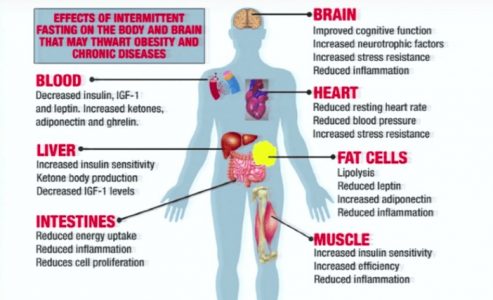
Some recent dietary and eating pattern trends have been shown to have positive benefits on health for many individuals.

The specific trends I am referring to include: low carb diets, intermittent fasting and compressed windows of feeding (such as 8/16 hours: eating during  a period of 8 hours and fasting for 16 hours.)

The following article from Natural News highlights some of the recent studies and health benefits of intermittent fasting.

I am sure many of you may have tried intermittent fasting yourselves and have recommended it to your patients: I certainly count myself in with this group, and I have seen some significant health benefits in some patients.

In the article, it highlights a specific study done at Harvard which was published in the journal Cell Metabolism.

Here is one of the key takeaways from the study:

“Manipulating mitochondrial networks inside cells — either by dietary restriction or by genetic manipulation that mimics it — may increase lifespan and promote health, according to new research from Harvard T.H. Chan School of Public Health.”

Read More