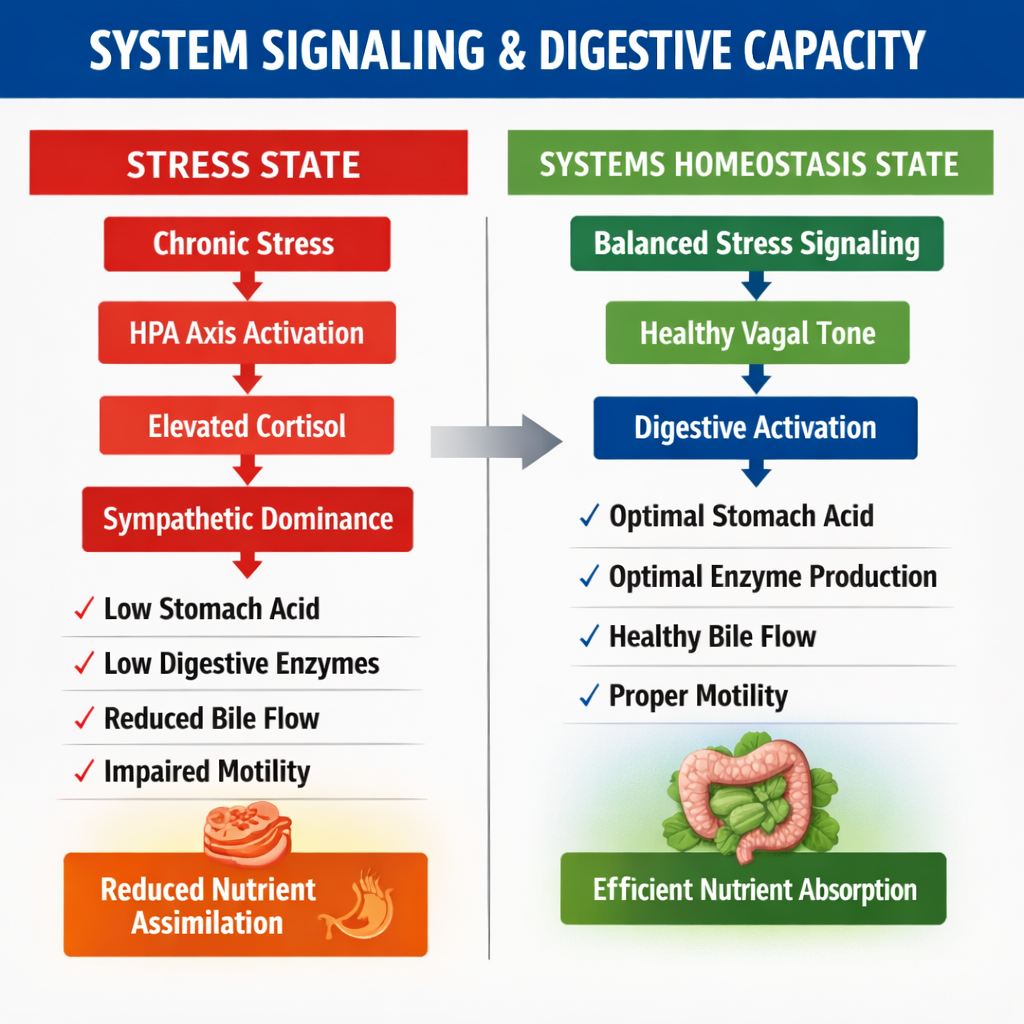
In this environment, the digestive organs themselves are often structurally normal.
What has changed is the regulatory signaling environment.
4. The systems homeostasis perspective
From the perspective of Systems Homeostasis, digestive dysfunction is often downstream of broader regulatory imbalance.
Persistent stress signaling shifts physiology toward a catabolic state in which:
Repair is deprioritized Nutrient assimilation declines Structural maintenance is reduced
The digestive system is responding appropriately to the signals it receives.
5. Implications for intervention
Supplemental digestive enzymes or hydrochloric acid can sometimes provide short-term support.
But when the underlying signaling environment remains dominated by chronic stress physiology, these interventions may only partially restore digestive capacity.
Supporting digestion therefore often requires addressing the regulatory systems that govern digestive signaling, including:
Circadian rhythm regulation Nervous system balance Metabolic stability Stress physiology
When the signaling environment shifts back toward parasympathetic regulation, digestive capacity frequently improves.
6. The key takeaway
Digestive dysfunction is not always a failure of digestive chemistry.
It is often a reflection of system signaling priorities.
When the body remains in a chronic catabolic stress state, digestion becomes secondary to survival.
Restoring digestive capacity therefore involves restoring the conditions of physiological regulation that allow the digestive system to function normally.
“This article is part of the Ingredient Intelligence™ series exploring how nutrients and compounds interact with physiological signaling and systems regulation.”
✴️ Work With Me
If you are developing nutritional supplements, botanicals, or functional beverages, I provide formulation strategy grounded in systems physiology and real-world clinical application.
For individuals and practitioners seeking clinical consulting rooted in systems homeostasis, metabolic regulation and adaptive capacity – not symptom chasing – my clinical services are available at:
Each week the nutritional supplement and functional beverage industry provides a snapshot of where consumer demand, ingredient innovation, and product formulation are heading.
The signals emerging this week point toward one clear theme:
The convergence of metabolic health, convenience, and functional delivery systems.
The line between supplements, beverages, and everyday foods continues to blur.
Here are the developments worth paying attention to.
1. Gut Health Continues to Dominate Innovation
Gut health remains one of the most active innovation spaces in the supplement industry.
Recent product launches and formulation strategies increasingly target the gut–brain axis, linking digestive health to mood, cognition, and metabolic regulation.
Brands launching new microbiome-focused formulations include companies such as Daily Nouri, O Positiv, and Cymbiotika, each emphasizing combinations of:
Prebiotic fibers
Next-generation probiotics
Postbiotics
Gut-supporting amino acids such as L-glutamine
Rather than simple digestive products, these formulations are now positioned as system-wide metabolic and neurological support tools.
For formulators, this trend reinforces an important shift: microbiome support is no longer a niche digestive category—it is becoming a central platform for multiple health claims.
2. Creatine Expands Beyond Sports Nutrition
Creatine continues to move rapidly beyond its traditional bodybuilding audience.
Increasingly, creatine is being positioned for:
Cognitive performance
Women’s health
Healthy aging
General metabolic support
Market projections suggest the global creatine market could reach approximately $4.2 billion by 2030, reflecting its growing acceptance as a general wellness compound rather than a purely athletic supplement.
One notable shift is the rapid expansion of consumer-friendly formats, including gummies, sachets, and functional beverage integrations.
For product developers, creatine now represents one of the few ingredients with strong clinical credibility that can be repositioned across multiple categories.
3. Healthy Aging Ingredients Continue Their Rise
Several ingredients associated with longevity and cellular metabolism continue gaining momentum in the supplement industry.
Among the most discussed in current product development pipelines:
NMN and NAD-related compounds
Shilajit
Sea moss
Companies such as Layn Natural Ingredients are expanding the NAD pathway category, preparing high-purity NAD ingredients alongside their existing NMN offerings.
This reflects a broader industry movement toward healthy aging formulations that target mitochondrial health, metabolic resilience, and cellular repair pathways.
Rather than single ingredients, many companies are now building multi-pathway longevity stacks.
4. Functional Beverages Move Beyond Hydration
Functional beverages continue evolving from simple hydration products into targeted health delivery systems.
Industry trend reports now describe this shift as “Beverages with Purpose.”
These drinks are increasingly formulated to support:
Energy and focus
Stress resilience
Immune health
Metabolic regulation
Gut health
Key ingredients currently driving beverage innovation include:
Adaptogens
Ashwagandha
Reishi
Nootropics
L-theanine
Lion’s mane mushroom
Microbiome support
Probiotics
Prebiotic fibers
At the same time, large beverage companies are entering the category with functional soda products, signaling that gut-health drinks may soon compete directly with traditional soft drinks.
5. Protein Innovation Responds to GLP-1 Demand
One of the most interesting formulation shifts is being driven by the rise of GLP-1 medications.
Consumers using these medications often require higher nutrient density in smaller volumes, which is influencing product development across both supplements and functional beverages.
Ingredient companies are responding.
For example, Roquette recently introduced NUTRALYS Pea 850F, a new pea protein isolate designed to solve one of the major challenges in plant protein products: off-flavor and bitterness.
Improved sensory profiles could significantly expand the use of plant proteins in:
Ready-to-drink protein beverages
Functional meal replacements
High-protein snack foods
6. Stress and Cortisol Support Products Expand
Stress management formulations continue to see strong growth.
One product attracting attention ahead of Expo West 2026 is CAVU Nutrition’s ThymoQuin Cortisol Support, built around TriNutra’s standardized black seed extract.
Clinical research suggests this ingredient may support reductions in cortisol while improving sleep and mood markers.
This reflects the broader rise of what some analysts call the “Anxiety Economy,” where consumers increasingly seek nutritional solutions for stress resilience.
Common ingredients appearing in these products include:
Saffron extract
Adaptogenic botanicals
Probiotics
Polyphenol-rich extracts
7. Regulatory Pressure Is Increasing
While innovation continues at a rapid pace, the regulatory environment is tightening.
In the United States, the FDA is signaling increased scrutiny of self-GRAS ingredient designations and NDIN pathways.
This could raise the barrier to entry for smaller supplement brands relying on novel ingredients without robust safety documentation.
For the industry, this means that clinical evidence, regulatory compliance, and ingredient transparency will become increasingly important competitive advantages.
Final Thoughts
Taken together, this week’s developments highlight several structural trends shaping the future of nutritional products:
• Gut health is evolving into a multi-system metabolic platform • Creatine is transitioning into mainstream wellness and cognitive health • Functional beverages are becoming health delivery systems • GLP-1 medications are reshaping nutrient density requirements • Healthy aging ingredients are driving longevity-focused product design
For formulation scientists, practitioners, and product developers, the opportunity lies in designing products that combine clinical credibility, sensory performance, and consumer convenience.
The next generation of supplements and functional beverages will likely emerge at the intersection of those three forces.
Work With Me
If you are a clinic, practitioner, or company developing nutritional supplements, botanicals, or functional beverages, I provide formulation strategy and development grounded in systems physiology and real-world clinical application.
HealthspanFormulations.com
For individuals or practitioners seeking clinical consulting rooted in systems homeostasis and metabolic regulation:
CAVU Nutrition — ThymoQuin Cortisol Support Standardized black cumin extract positioned for stress, sleep, and metabolic balance.
Stress resilience is becoming a primary commercial narrative.
2026 Category Acceleration Map
High-growth segments:
Creatine beyond sport
Longevity & mitochondrial support
Gut health & postbiotics
Nootropics
Nitric oxide
Hydration/electrolytes
Beauty-from-within
Adaptogens
Functional beverages
But here is the deeper pattern:
The innovation is no longer just ingredient-driven.
It is systems-positioning driven.
Brands are moving toward structured signaling logic — even if they don’t explicitly call it that.
Strategic Conclusion
The companies winning in 2026 will combine:
Cellular-level positioning
Delivery innovation
Clean-label transparency
Age-inclusive messaging
Structured portfolio architecture
We are not in a capsule race.
We are in a metabolic resilience race.
—
If you are a clinic, practitioner, or company developing nutritional supplements, botanicals, or functional products, I provide formulation strategy and development grounded in systems physiology and real-world clinical application. 👉 HealthspanFormulations.com
For individuals and practitioners seeking clinical consulting rooted in systems homeostasis, metabolic regulation, and adaptive capacity—not symptom chasing—my clinical services are available at: 👉 OptimumHealthConsulting.com
Substrate Availability, Signalling Fidelity, and Systems Throughput
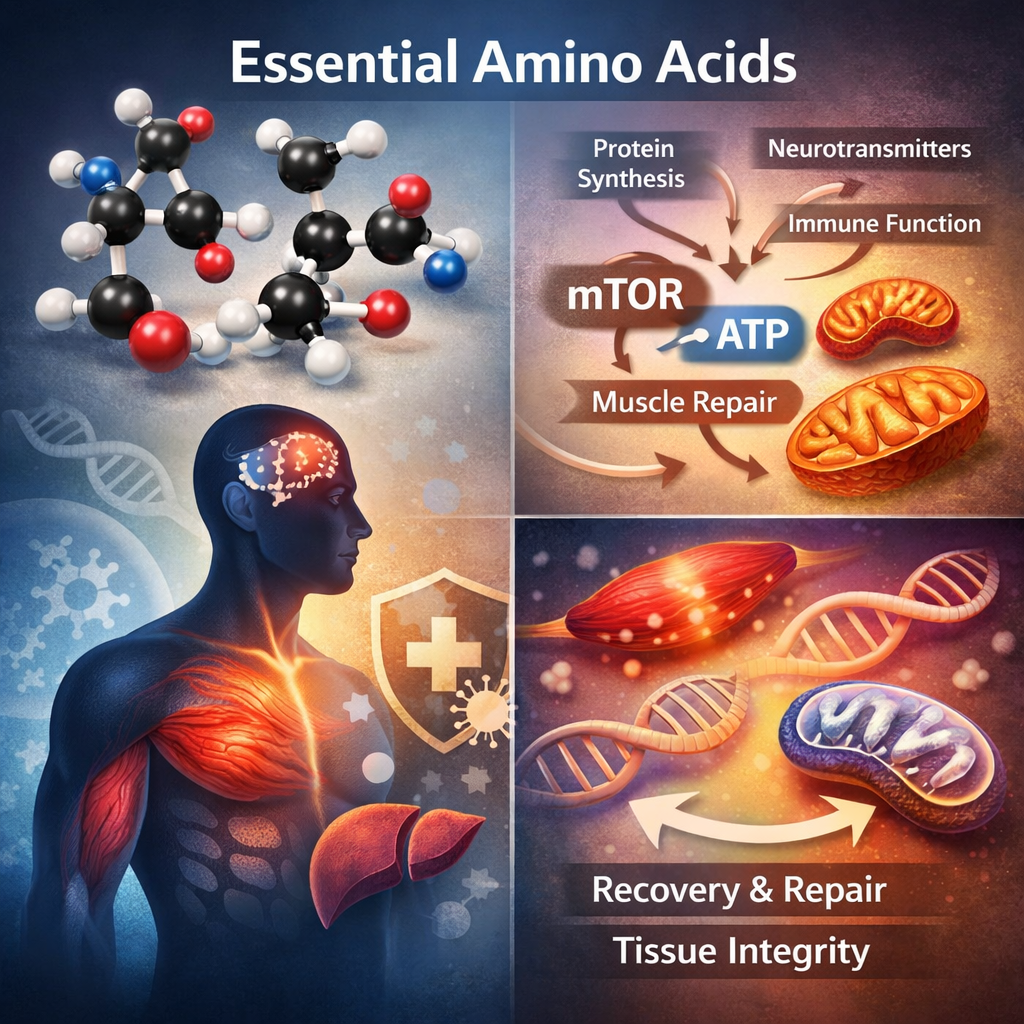
Essential amino acids (EAAs) are often discussed in the context of muscle growth or athletic performance. From a systems homeostasis perspective, this framing is incomplete and frequently misleading.
EAAs are not performance agents.
They are foundational substrates that determine whether the body can maintain structure, complete repair, and sustain adaptive capacity.
They do not initiate change.
They determine whether change can finish.
Essential Amino Acids as a Systems Constraint
A biological system cannot express resilience without material availability.
In states of:
chronic psychological or physiological stress
aging
illness or recovery
inflammatory load
under-eating
impaired digestion
metabolic rigidity
…the primary limitation is often not signalling, motivation, or hormonal drive. It is substrate access.
Tissue repair, enzyme production, immune turnover, neurotransmitter synthesis, and mitochondrial protein renewal all require essential amino acids. When availability is insufficient, the system compensates by reallocating internal resources — most commonly through tissue breakdown.
This is not a deficiency model.
It is a capacity erosion model.
Protein Intake Is Not the Same as Amino Acid Availability
Whole protein intake is frequently assumed to equal amino acid sufficiency. Physiologically, this assumption often fails.
Whole proteins require:
adequate gastric acid
sufficient protease activity
intact intestinal absorption
hepatic processing capacity
In many individuals — particularly those under stress, aging, inflamed, or ill — these steps are rate-limiting.
EAAs reduce friction in the system:
minimal digestive burden
predictable absorption
direct availability for synthesis and repair
From a systems standpoint, EAAs function as low-complexity building inputs when upstream access is constrained.
This is not optimization.
It is structural triage.
Signalling Without Substrate Is Unproductive
Modern health culture places enormous emphasis on signalling:
training stimuli
metabolic stress
hormonal cues
pathway activation (mTOR, AMPK, etc.)
Signalling without substrate does not produce adaptation.
It produces incomplete work.
Without adequate EAAs:
training becomes catabolic
recovery stalls
immune turnover slows
detoxification pathways falter
structural integrity declines
This is why individuals can be “doing everything right” and still deteriorate.
The signal is present.
The materials are not.
Aging, Illness, and Amino Acid Economics
With aging, several predictable shifts occur:
reduced appetite
impaired digestion
anabolic resistance
increased inflammatory tone
slower protein turnover
In illness and recovery states:
amino acid demand increases
immune and tissue turnover accelerates
tolerance for large protein loads often declines
In these contexts, EAAs may function as:
anti-catabolic support
repair permission
structural insurance
Not to build more — but to lose less.
This distinction is critical.
EAAs and Metabolic Flexibility
EAAs sit downstream of metabolic flexibility.
They do not force adaptation.
They allow adaptation to complete once the system is ready.
In flexible systems, EAAs support recovery and rebuilding.
In constrained systems, they may reduce tissue loss — but they cannot override poor sequencing.
They are supportive substrates, not corrective interventions.
What EAAs Do Not Fix
From a systems homeostasis perspective, EAAs do not:
repair digestive dysfunction
override stress dominance
correct sleep disruption
compensate for inflammatory overload
replace whole-food nutrition
resolve sequencing errors
Used incorrectly, EAAs delay recognition of deeper constraints.
Used correctly, they preserve capacity so recovery can proceed without additional burden.
Systems Takeaway
Essential amino acids are not about enhancement.
They are about structural permission.
They determine whether the system can:
repair
adapt
maintain
or must cannibalize itself to survive
This is why EAAs belong exactly where they sit in the Ingredient Intelligence™ sequence:
after digestive capacity
after metabolic flexibility
as substrates for rebuilding — not signalling
Ingredient Intelligence™ Summary
EAAs are substrates, not stimulants
They support completion of repair, not initiation
Their value increases as digestive and adaptive reserve decline
They cannot compensate for poor sequencing
Properly used, they preserve systems capacity
Formulation & Product Development
If you are a clinic, practitioner, or company developing nutritional supplements, amino acid formulations, or functional products, I provide formulation strategy and product development grounded in systems physiology and real-world clinical application.
HealthspanFormulations.com
Clinical Consulting
For individuals and practitioners seeking clinical consulting rooted in systems homeostasis, metabolic regulation, and adaptive capacity — not symptom chasing, my clinical services are available at:
Glycine is often dismissed as a minor, non-essential amino acid—something structural, supportive, and unremarkable. That view misses its real role.
From a systems homeostasis perspective, glycine is less about “doing more” and more about allowing systems to settle, integrate, and resolve signals appropriately.
Glycine as a Signalling Modulator
Physiology is governed not just by excitatory signals, but by the ability to contain and resolve them. Glycine functions as an inhibitory co-signal across multiple systems, helping define thresholds rather than pushing outcomes.
In the nervous system, glycine contributes to inhibitory tone, shaping how signals are interpreted rather than amplified. This matters because many modern stress patterns are not driven by a lack of stimulation, but by impaired signal dampening.
More excitation is rarely the answer when tolerance is already narrow.
Structural Roles That Influence Signalling
Glycine is a major constituent of collagen and connective tissue. This is not merely structural trivia. Tissue integrity influences circulation, mechanotransduction, and intercellular communication. When structure is compromised, signalling becomes distorted—often louder, more inflammatory, and less precise.
By supporting connective tissue integrity, glycine indirectly supports signal clarity and delivery, not by force, but by maintaining the medium through which signals move.
Osmoregulation, Cellular Calm, and Recovery
At the cellular level, glycine participates in osmotic balance and cytoprotective processes. These functions help cells maintain volume, membrane stability, and internal order under stress.
In systems terms, this is containment—the ability to remain coherent under load.
Containment precedes adaptation. Without it, signalling becomes chaotic and recovery stalls.
Why Glycine Matters in a Signalling-Saturated World
Many individuals today live in a state of persistent signalling pressure: metabolic, inflammatory, neurological, and psychological. In this context, adding more “drivers” often backfires.
Glycine represents the opposite philosophy:
not escalation
not optimization
but restoration of signal boundaries
It supports the system’s ability to decide appropriately, rather than react indiscriminately.
A Systems Takeaway
Glycine’s value is not that it stimulates change, but that it permits resolution.
From a systems homeostasis lens, resilience depends as much on inhibitory capacity as on activation. Systems fail not only when signals are too weak—but when they cannot be turned off.
Glycine reminds us that sometimes the most powerful intervention is the one that reduces noise, preserves tolerance, and allows physiology to return to baseline on its own terms.
Ingredient Intelligence™ is a systems-first series exploring how nutrients and compounds function as signals, not isolated fixes—always through the lens of context, capacity, and adaptive reserve.
Formulation & Systems Consulting
If you are a clinic, practitioner, or company developing nutritional supplements, botanicals, or functional products, I provide formulation strategy and development grounded in systems physiology and real-world clinical application.
HealthspanFormulations.com
Clinical Consulting
For individuals and practitioners seeking clinical consulting rooted in systems homeostasis, metabolic regulation, and adaptive capacity—not symptom chasing—my clinical services are available at:
Neuroplasticity declines in low-signal environments
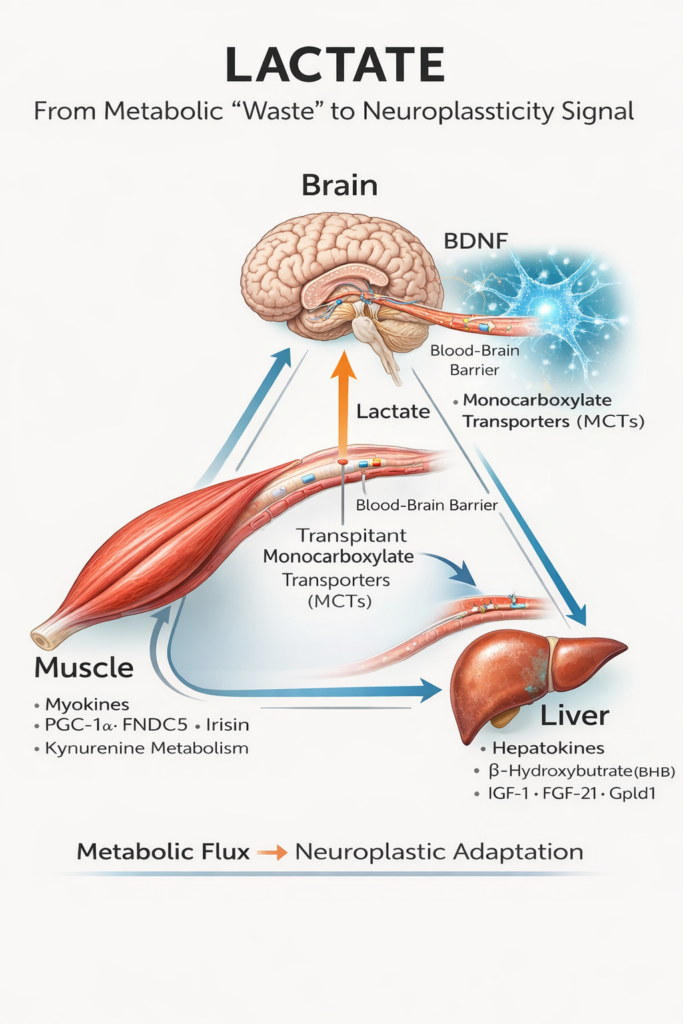
5. Lactate in Context — Not in Isolation
Lactate does not act alone.
It operates alongside other exercise-induced signaling molecules, including:
β-Hydroxybutyrate (BHB) — a liver-derived gene-regulating signal
Irisin (FNDC5 pathway) — a muscle-derived neurotrophic messenger
The Takeaway
The body does not merely burn fuel.
It communicates through metabolism.
The brain does not simply respond to nutrients.
It adapts in response to signals generated by action.
Lactate is one of those signals — and without it, adaptive brain biology breaks down.
Formulation / Product Development
If you are a clinic, practitioner, or company developing nutritional supplements, botanicals, or functional products, I provide formulation strategy and development grounded in systems physiology and real-world clinical application.
HealthspanFormulations.com
Clinical Consulting
For individuals and practitioners seeking clinical consulting rooted in systems homeostasis, metabolic regulation, and adaptive capacity — not symptom chasing — my clinical services are available at:

 HealthspanFormulations.com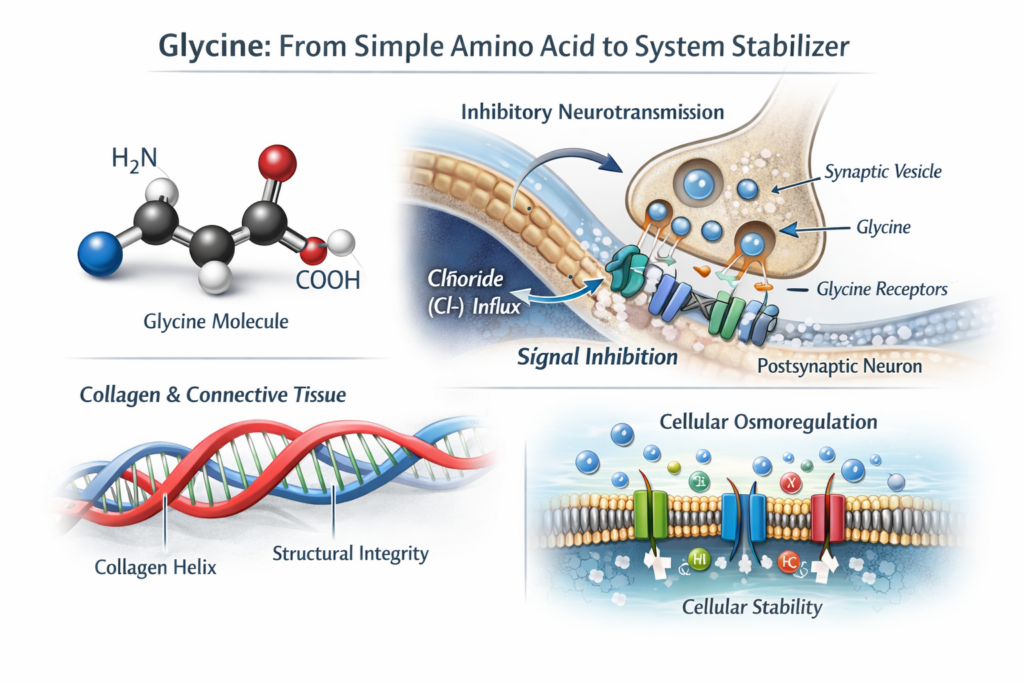
 Ingredient Intelligence™ Vol. 4.25