Education and Courses
Education and Courses
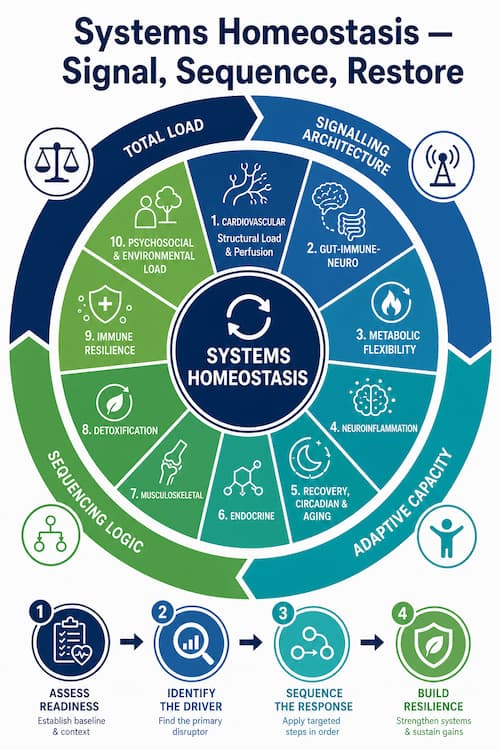
These programmes train clinicians, health professionals, and motivated individuals to understand physiology at the level of systems, signals, and sequencing — rather than protocols, targets, and optimisation.
There are three distinct educational offerings on this page. Each is built on the same Systems Homeostasis framework. They differ in audience, depth, and application.
Metabolic Flexibility & Energy Access
A six-module public course. USD 97.00
Most health advice is built around what to add: better nutrition, more supplements, the right protocol. This course is built around something prior to all of that — understanding what your body is actually doing, and why.
The Systems Homeostasis framework teaches that chronic fatigue, metabolic instability, and failed interventions are not random. They are coherent outputs of a system that has shifted its priorities from repair and function to protection and survival. That shift has a logic. Understanding it changes everything about how you approach your health.
| Module | What It Addresses |
| 1 — The Invisible Drain | Why chronic symptoms appear together and why nothing seems to hold. Total load as the framework. |
| 2 — Signalling Safety | The nervous system as master regulator. Why the body prioritises survival over repair — and how that changes. |
| 3 — The Spark | Why eating well doesn’t guarantee energy. The difference between intake and access. |
| 4 — The Rhythm | How timing and consistency act as regulatory signals. Why pattern matters more than perfection. |
| 5 — The Battery | The difference between energy quantity and energy capacity. Why pushing harder fails. |
| 6 — The Resilient Life | What it looks like when the system works. From fixing symptoms to building adaptability. |
This course does not provide protocols, supplement recommendations, or dietary prescriptions. It provides a framework — the same one that informs systems-based clinical practice at a professional level — presented in language accessible to a motivated adult without a clinical background.
Who this course is for: Intelligent, motivated adults who have already tried the standard approaches and found they don’t hold. People who want to understand what is happening in their body before trying another intervention. Not for people looking for a protocol, a plan, or a quick fix.
Systems Homeostasis Foundations
Professional prerequisite course. Waitlist open.
The Foundations course is the prerequisite pathway into the Advanced Professional Course for practitioners who do not hold a prior qualification in functional or integrative nutrition or medicine.
It covers the core physiological architecture of Systems Homeostasis — the same framework taught at an introductory level in the public course, delivered here at clinical depth for health professionals and practitioners across all disciplines. On completion, graduates meet the prerequisite standard for Advanced Professional Course entry.
Who this course is for: Health professionals, allied health practitioners, coaches, and motivated clinicians from any discipline who want to build a foundational understanding of systems-based clinical reasoning before entering the Advanced Professional Course.
Systems Homeostasis Advanced Professional Course
Ten-domain advanced program for clinicians and health professionals.
Prerequisites: Completion of the Systems Homeostasis Foundations course, or equivalent qualification in functional or integrative nutrition, naturopathic medicine, or clinical practice. Entry is by assessment.
The Advanced Professional Course trains clinicians and health professionals to assess system readiness, sequence interventions safely, and reason through complex multi-domain presentations using a coherent physiological architecture.
It is not built around conditions or diagnoses. It is built around systems and the signals those systems generate. Graduates leave with the clinical reasoning architecture and formulation intelligence to understand why interventions succeed or fail — and what to do when they don’t.
The Formulation Intelligence Engine™ (FIE) — Rob Lamberton’s proprietary clinical tool — is embedded throughout the course and forms the capstone module. The FIE provides a governed, signal-based framework for clinical protocol generation that is unique to the Systems Homeostasis methodology.
| # | Domain | Layer |
| 1 | Cardiovascular & Structural Resilience | Systemic load layer |
| 2 | Gut–Immune–Neuro Signalling | Terrain layer |
| 3 | Metabolic Flexibility & Fuel Utilisation | Resource layer |
| 4 | Neuroinflammation & Cognitive Load | Neural signalling layer |
| 5 | Endocrine Architecture & Hormonal Signalling | Hormonal governance layer |
| 6 | Recovery, Circadian & Aging Systems | Integration layer |
| 7 | Structural Integrity & Connective Tissue | Structural capacity layer |
| 8 | Immune Resilience & Infection Tolerance | Systemic immune layer |
| 9 | Detoxification & Biotransformation | Clearance layer |
| 10 | Psychosocial & Environmental Load | Contextual load layer |
Each domain includes a full teaching module, worked clinical cases, self-assessment, and cross-domain signal mapping. The programme concludes with the FIE Capstone Module — a complete clinical application module teaching practitioners to generate governed intervention protocols from the FIE signal architecture.
| Founding cohort pricing available — enquire → Enquire about the program |
About Rob Lamberton
Rob Lamberton BSc, FNTP, FDN-P(c) works at the intersection of functional lab interpretation, systems physiology, formulation science, and clinical pattern recognition. He is the architect of the Systems Homeostasis framework and the Formulation Intelligence Engine™ — a clinical methodology and proprietary toolset that examines health through the lens of signalling architecture, receiver state assessment, and sequencing logic.
His educational work spans three tiers: a public course designed to make the framework accessible to motivated individuals without a clinical background; a Foundations programme for practitioners building their functional medicine grounding; and an Advanced Professional Course for clinicians who want to apply the framework at depth. All three are built on the same foundational architecture, differing in audience, depth, and application.
All educational programmes are developed with explicit attention to scope, practitioner safety, and international applicability across multiple professional licensing frameworks.