Lactate: From Metabolic “Waste” to Neuroplasticity Signal
 Ingredient Intelligence™ Vol. 4.25
For decades, lactate has been misunderstood.
It has been framed as:
- A byproduct of poor oxygen delivery
- A marker of fatigue
- Something the body needs to “clear”
Modern physiology tells a very different story.
Lactate is not waste.
Lactate is a signal.
And in the brain, it is a neurotrophic signal.
1. Lactate Is Actively Transported Into the Brain
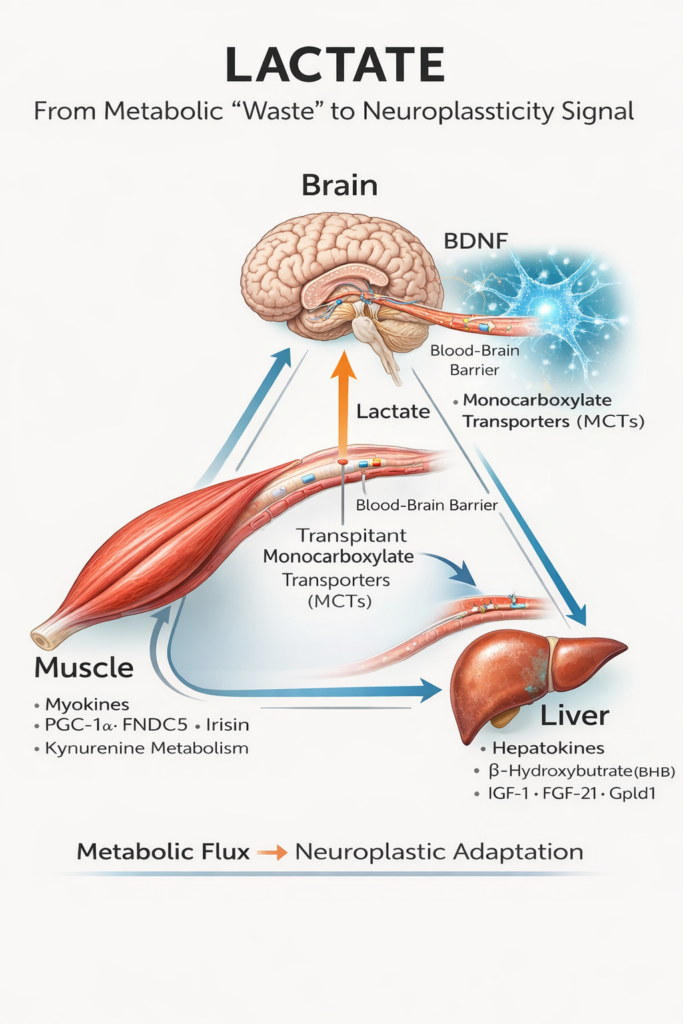
During physical exertion, skeletal muscle produces lactate as a normal consequence of glycolytic flux.
Rather than accumulating uselessly, lactate:
- Enters circulation
- Crosses the blood–brain barrier via monocarboxylate transporters (MCTs)
- Is preferentially taken up by neurons and astrocytes
This transport is regulated, not accidental.
When lactate transport is blocked, the downstream brain effects disappear.
2. Lactate Directly Activates BDNF Gene Expression
Once inside the brain—particularly the hippocampus—lactate acts as a metabolic signal that:
- Activates transcriptional pathways
- Increases BDNF gene expression
- Enhances synaptic plasticity and neurogenesis
This is not motivational language.
It is molecular signaling.
When lactate signaling is blocked, exercise fails to induce neuroplastic adaptations.
3. Lactate Is a Coordination Signal, Not Just Fuel
Lactate can be oxidized by neurons — but fuel delivery is not its primary importance.
Its dominant role is informational:
- Signaling energetic demand
- Coordinating peripheral effort with central adaptation
- Linking muscle activity to brain remodeling
Lactate functions as part of a distributed communication network between muscle, liver, and brain.
4. Why This Matters Clinically
From a systems-homeostasis perspective:
- Chronically avoiding metabolic challenge reduces adaptive signaling
- Cognitive resilience depends on signal integrity, not comfort
- Supplements cannot replace missing physiological inputs
This explains why:
- “Exercise mimetics” underperform
- Nutrients alone fail to restore cognition or mood
- Neuroplasticity declines in low-signal environments
5. Lactate in Context — Not in Isolation
Lactate does not act alone.
It operates alongside other exercise-induced signaling molecules, including:
- β-Hydroxybutyrate (BHB) — a liver-derived gene-regulating signal
- Irisin (FNDC5 pathway) — a muscle-derived neurotrophic messenger
The Takeaway
The body does not merely burn fuel.
It communicates through metabolism.
The brain does not simply respond to nutrients.
It adapts in response to signals generated by action.
Lactate is one of those signals — and without it, adaptive brain biology breaks down.

Formulation / Product Development
If you are a clinic, practitioner, or company developing nutritional supplements, botanicals, or functional products, I provide formulation strategy and development grounded in systems physiology and real-world clinical application.
 HealthspanFormulations.com
Clinical Consulting
For individuals and practitioners seeking clinical consulting rooted in systems homeostasis, metabolic regulation, and adaptive capacity — not symptom chasing — my clinical services are available at:
OptimumHealthConsulting.com

#IngredientIntelligence
#SystemsHomeostasis
#Neuroplasticity
#MetabolicSignaling
#BDNF
#ExerciseBiology
#FunctionalNutrition
#NutraceuticalScience
#RobLamberton
#RobertLamberton