NEW STUDY: Intranasal Nano-Ivermectin Shrinks Brain Tumors by 70% Without Toxicity
Ivermectin shown to have yet another significant potential benefit!
Content paraphrased from a Focus Points – Courageous Discourse Substack article by Nicolas Hulscher, MPH
Epidemiologist and Foundation Administrator, McCullough Foundation
https://mcculloughfnd.org
Landmark preclinical study shows intranasal ivermectin nanocapsules safely shrink glioblastoma in animal models at doses lower than the approved human antiparasitic dose.
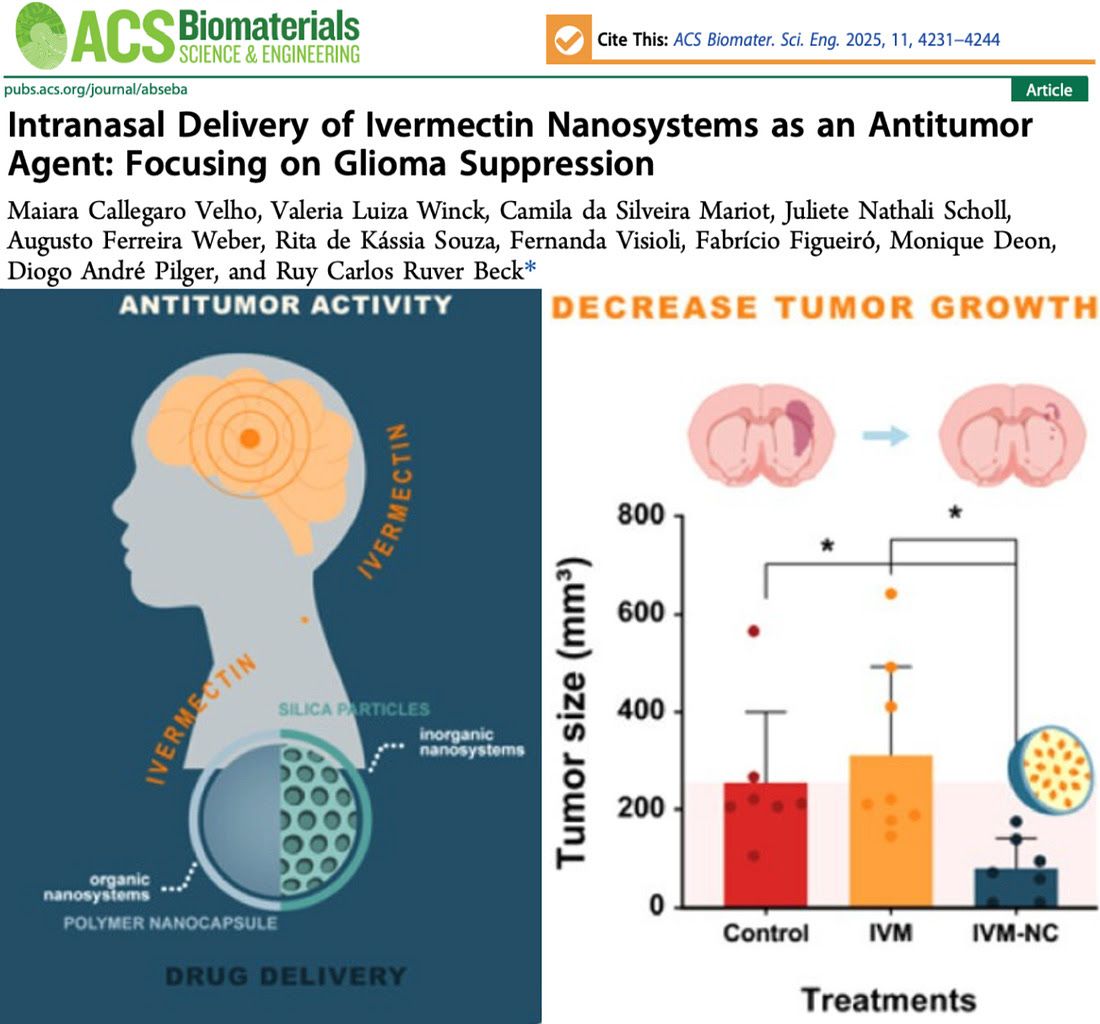
Tumor Size Reduced by 70%
After just 10 days of treatment:
✅Control tumors averaged 254 mm³
✅IVM-NC tumors averaged only 79 mm³ — a 70% reduction in size, confirmed by histopathology
✅Non-encapsulated (free) ivermectin — given the same intranasal route — had no measurable effect
Zero Detectable Toxicity
At the same time, the nano-formulated ivermectin showed no adverse effects:
✳️No changes in body weight, liver, or kidney markers
✳️No lung inflammation, hemorrhage, or edema
✳️No cytotoxicity in normal fibroblast cell lines
✳️Even at repeated daily doses, the treatment remained completely well-tolerated.
✳️By contrast, the non-nano (free) ivermectin and silica nanoparticle formulations both caused tissue irritation and cell death at higher concentrations.
✅ These findings align with ivermectin’s 14 distinct anti-cancer mechanisms summarized by Yuwen et al., encompassing inhibition of oncogenic signaling (YAP1, Wnt–TCF, Akt/mTOR, EGFR/NF-κB, MAPK), mitochondrial and oxidative-stress induction, ion-channel modulation, and suppression of both cancer stem cells and the epithelial–mesenchymal transition (EMT).
✅ By hitting multiple hallmarks of cancer simultaneously — proliferation, metabolism, invasion, and survival — ivermectin appears to function as a multi-targeted anti-tumor agent. In glioblastoma, these converging effects explain the 70% tumor-volume reduction observed with intranasal nano-ivermectin, achieved at doses below standard antiparasitic levels and without toxicity.
✅ Clinical translation in humans is urgently needed. Encouragingly, this effort may already be underway. On September 24, 2025, Governor Ron DeSantis and First Lady Casey DeSantis announced a $60 million funding opportunity through the Florida Cancer Innovation Fund, prioritizing translational cancer research, short-duration clinical trials, and the repurposing of safe, generic drugs such as ivermectin for cancer treatment.