Education & Courses
Systems Homeostasis & Applied Human Systems Physiology
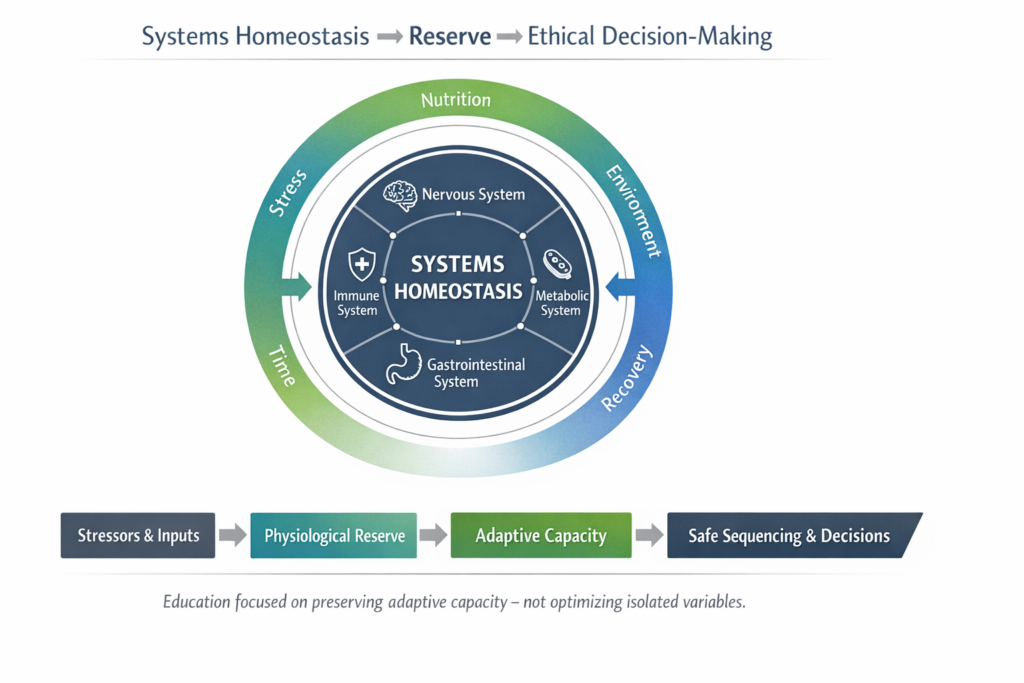
Education focused on preserving adaptive capacity – not optimizing isolated variables
These programs train clinicians and health professionals to assess system readiness, sequence interventions safely, and avoid capacity-eroding overreach in complex cases.
Modern health challenges rarely arise from a single cause. They emerge from interacting physiological systems, cumulative stressors, and declining adaptive capacity over time.
My educational programs are designed to train practitioners and professionals to think in terms of systems homeostasis, physiological reserve, and safe sequencing of interventions—rather than protocol stacking or short-term optimization.
Education grounded in resilience, physiological humility, and long-term outcomes.
This page outlines the philosophy, scope and structure of current and planned educational programs.
 SECTION 2 — Intended Audiences & Educational Tracks
Block type:
 Group block
3 Columns inside
Column 1 — Allied Health & Nutrition
Allied Health & Nutrition Professionals
- Registered Dietitians (RDs)
- Nutritionists
- Allied health practitioners
- Health coaches (education-only, scope-aware track)
Column 2 — Medical & Clinical Track
Medical & Clinical Track
- Medical Doctors (MD / MBChB / MBBS)
- Doctors of Osteopathy (DO)
- Naturopathic Doctors (ND)
- Nurse Practitioners (NP)
- Other clinically licensed practitioners (jurisdiction-dependent)
Column 3 — Educators & Advanced Learners
Advanced Learners & Educators
- Health sciences educators
- Integrative & functional medicine professionals
- Faculty, program directors, and institutions
Small text under columns (Paragraph block):
Courses are structured with track-specific depth and scope boundaries, ensuring ethical, non-prescriptive, and regulator-safe education across regions.
SECTION 3 — GLOBAL MEDICAL DESIGNATIONS
Block type:
Group block (narrow width)
Heading (H3)
Global Medical Degree Designations
Medical degree titles vary internationally, including:
- MD — North America and parts of Europe
- MBChB / MBBS — Africa, UK, and Commonwealth countries
- DO — United States
- ND — Licensed in select jurisdictions
All medical-track education emphasizes systems physiology and clinical reasoning, not jurisdiction-specific treatment protocols.
SECTION 4 — CORE EDUCATIONAL THEMES
Block type:
Group block
Bullet list
Heading (H2)
Core Educational Themes
- Systems homeostasis and physiological regulation
- Stress, adaptation, and recovery dynamics
- Metabolic flexibility as adaptive capacity
- Energy availability → inflammation → frailty
- Physiological reserve and treatment tolerance
- Why over-optimization fails in complex systems
- Clinical decision-making under energetic constraint
SECTION 5 — EDUCATIONAL PHILOSOPHY
Block type:
Group block
Heading (H2)
Educational Philosophy
Most health education focuses on what to add.
This curriculum focuses on:
- When not to add
- How much is too much
- Why good interventions can cause harm
- How systems lose resilience over time
Bold paragraph (or Quote block):
Robustness beats optimization.
Stability precedes intensity.
Capacity determines what is safe.
SECTION 6 — COURSE FORMATS
Block type:
Group block
Bulleted list
Heading (H2)
Course Formats (Planned)
- Online self-paced education
- Modular professional programs
- Case-based learning & decision frameworks
- Faculty-led workshops and intensives
- Institution-specific or regional programs
SECTION 7 — INTERNATIONAL CONTEXT
Block type:
Group block
Heading (H2)
International & Institutional Context
The curriculum is designed for international applicability, including:
- North America
- UK / Europe
- East Africa
Content is culturally adaptable, regulator-aware, and suitable for institutional adoption.
About the Program Director
Rob Lamberton is a systems-focused educator and practitioner working at the intersection of human physiology, clinical reasoning, and formulation science. His work centers on understanding how stress load, metabolic constraint, and declining physiological reserve shape health outcomes over time.
He has trained and worked across nutrition, functional and integrative health, and formulation development, with experience spanning clinical practice, practitioner education, and industry collaboration. His educational approach emphasizes systems homeostasis, ethical sequencing, and long-term resilience rather than protocol-driven optimization.
All educational programs are developed with explicit attention to scope, regulator safety, and international applicability.
Download the Systems Homeostasis & Applied Human Systems Physiology Framework Overview (PDF)
SECTION 8 — CALL TO ACTION
Block type:
Group block
Button block
Heading (H2)
Interested in Courses or Partnerships?
If you are a practitioner, clinic, or institution interested in education or collaboration:
Button text:
 Enquire About Education Programs
Button link:
SECTION 9 — FAQ (Accordion Recommended)
Block type:
Accordion / Toggle blocks
FAQ items:
Do these courses replace professional training or licensure?
Answer: No. These programs are educational in nature and do not replace formal professional training, licensure or clinical supervision
Is this medical training?
No. The education focuses on systems physiology, clinical reasoning, and decision-making frameworks. It does not provide medical, diagnostic, or treatment training.
Is this suitable for Naturopathic Doctors?
Yes. The material is suitable for Naturopathic Doctors and other licensed practitioners when used within appropriate educational and professional scope.
Do you teach protocols?
No. The emphasis is on principles, system dynamics, sequencing, and capacity-aware decision-making rather than prescriptive protocols.
Are courses available now?
Some programs are in development. Availability will vary by educational track, region, and institutional partnership.
Do these courses replace professional training or licensure?
No. These programs are intended to complement—not replace—formal professional education, licensure, or clinical supervision.